There was a spirited crowd at Peterson Middle School on Wednesday night, eager to learn more about the most important City-wide initiative of the century -- Measure J, the Stadium Subsidy.
And, learn they did. Kolstad & Kennedy covered topics as varied as the technical minutia of redevelopment law, school financing, game-day public safety measures and the stadium's potential impact on our perilously overdrawn City budget.
They even discussed campaign finance reform:
While we were not able to capture every moment of the evening's proceedings, we have posted as much as we could on youtube, where you will find discussions on:
Sit back, grab a bag of popcorn & let the good times roll!
Showing posts with label money. Show all posts
Showing posts with label money. Show all posts
Sunday, May 9, 2010


Sunday, April 25, 2010
Stop the Bleeding -- Vote No on J!
With this year's $13.5 Million deficit (expected to grow further next year) the City of Santa Clara is sinking from the ranks of fiscally sound, well-managed cities. It's saddening that we may lose yet another guaranteed $5 Million per year in rent from our fabled theme park, Great America.
Saddening, but not surprising. We already provide an annual give-away of $2.5 Million to the San Francisco 49ers' in the form of below-market rent on their training center.
Measure J extends that deal and expands the loss. The San Francisco 49ers would rent a brand new, state-of-the-art stadium for 25% of fair market value of the land it sits on!
Worse, they'd pay only 14% of the land's fair market value during the first 10 years of operation. Over the next two years, as our deficits sky-rocket, they'd pay nothing.
Saddening, but not surprising. We already provide an annual give-away of $2.5 Million to the San Francisco 49ers' in the form of below-market rent on their training center.
Measure J extends that deal and expands the loss. The San Francisco 49ers would rent a brand new, state-of-the-art stadium for 25% of fair market value of the land it sits on!
Worse, they'd pay only 14% of the land's fair market value during the first 10 years of operation. Over the next two years, as our deficits sky-rocket, they'd pay nothing.
Sunday, April 18, 2010
"Net Present Value" vs. "Actual Dollars"
Mayor Mahan & Councilmember Matthews have revolutionized the housing market with their discovery that "net present value figures ... are based on outdated economic assumptions" and that we should focus on "actual dollars" paid over 40 years!
Madam Mayor, I'll buy your home for $1 million -- a good $100,000 over the current market price. I'll pay you in 2050. Do we have a deal? Can you vacate by next Tuesday?
Fair Market Rent for the proposed stadium site is currently over $1.8 million per year. Even with the new Mahan-Matthews Math, that should be worth over $72 million in "actual dollars." Too bad the 49ers LLC only signed up for $40 million.
This is a bad deal -- with or without the lies the Mayor is spreading.
Madam Mayor, I'll buy your home for $1 million -- a good $100,000 over the current market price. I'll pay you in 2050. Do we have a deal? Can you vacate by next Tuesday?
Fair Market Rent for the proposed stadium site is currently over $1.8 million per year. Even with the new Mahan-Matthews Math, that should be worth over $72 million in "actual dollars." Too bad the 49ers LLC only signed up for $40 million.
This is a bad deal -- with or without the lies the Mayor is spreading.
Wednesday, December 5, 2007
Just barely above junk bonds
The 49ers would like Santa Clara taxpayers to believe that building, owning and operating this stadium will be a fabulous investment of our money. Better than buying Google stock at $100, or Sunpower at $25.
Some members of City Council are all but ready to put on Gold Rush outfits to repeat that chant.
But if it's such a screaming good deal, why haven't the 49ers themselves scooped it up yet? Or the city of San Francisco, which has been looking this over even longer than we have?
Well, one source for impartial opinions turns out to be the bankers, because to build a 68,000 seat stadium, the city will have to borrow a lot of money. The bankers are the ones who will have to take a hard look at the deal and decide how risky it is. The bankers have no personal attachments to this, only their money. And money itself is neutral.
At the November 20 City Council meeting, David Brodsly, the city's own bond consultant struggled to spit out the cold hard facts: the Stadium Authority bonds will be BBB-rated -- just one step above junk bonds!
Besides the bruised egos ("They think our pride and joy is junk!") there is also the practical matter of bond interests. Safe loans have lower interest rates. Risky loans have higher interest rates (think pay-day loan.) Higher interest rates drive up the total cost of borrowing of money. Ultimately this will make it harder for the stadium to break even.
Nobody on City Council batted an eyelash at this. Here we are, mortgaging our future for this white elephant, but nobody even registered a reaction when a disinterested bystander calls it a turkey.
Here's a video clip of the remarks, with a transcript:
Santa Clara resident Don Buchanan: "What kind of a rating do you think this bond will receive?"
David Brodsly, Managing Director, KNN Public Finance (the city's bond consultant): "The two bond issues that are ... umm ... being contemplated by the Stadium Authority ... they would be the [inaudible] ... the ... the admissions bond would probably be in the BBB level which is the bottom of the investment grade range, that's ... it's ... that ... it's the less certain area of the market, but that's ... that's a good guess standing here today."
Some members of City Council are all but ready to put on Gold Rush outfits to repeat that chant.
But if it's such a screaming good deal, why haven't the 49ers themselves scooped it up yet? Or the city of San Francisco, which has been looking this over even longer than we have?
Well, one source for impartial opinions turns out to be the bankers, because to build a 68,000 seat stadium, the city will have to borrow a lot of money. The bankers are the ones who will have to take a hard look at the deal and decide how risky it is. The bankers have no personal attachments to this, only their money. And money itself is neutral.
At the November 20 City Council meeting, David Brodsly, the city's own bond consultant struggled to spit out the cold hard facts: the Stadium Authority bonds will be BBB-rated -- just one step above junk bonds!
Besides the bruised egos ("They think our pride and joy is junk!") there is also the practical matter of bond interests. Safe loans have lower interest rates. Risky loans have higher interest rates (think pay-day loan.) Higher interest rates drive up the total cost of borrowing of money. Ultimately this will make it harder for the stadium to break even.
Nobody on City Council batted an eyelash at this. Here we are, mortgaging our future for this white elephant, but nobody even registered a reaction when a disinterested bystander calls it a turkey.
Here's a video clip of the remarks, with a transcript:
Santa Clara resident Don Buchanan: "What kind of a rating do you think this bond will receive?"
David Brodsly, Managing Director, KNN Public Finance (the city's bond consultant): "The two bond issues that are ... umm ... being contemplated by the Stadium Authority ... they would be the [inaudible] ... the ... the admissions bond would probably be in the BBB level which is the bottom of the investment grade range, that's ... it's ... that ... it's the less certain area of the market, but that's ... that's a good guess standing here today."
Tuesday, November 6, 2007
The cold, cruel truth
These words of wisdom are from Ray Ratto's recent article on the A's stadium — Time to call A's owner for crying wolf on stadium — but the analysis holds just as true for the current San Francisco 49ers' request for a massive public subsidy from the City of Santa Clara . . .
the cold, cruel truth, proven again and again by economists everywhere, is that stadiums have not paid off for anyone except for the team owners.
Monday, November 5, 2007
Starbucks on Mars
The article is almost a year old — A stadium in Santa Clara? You'll be dead before it happens — but every time I read this line . . .
. . I have just a little hope that fiscal sanity will triumph over reckless spending in Santa Clara. [And if it doesn't, maybe the latte run will be just a bit more exciting.]
Thanks Scott Ostler!
There will be a Starbucks on Mars before there's a 49ers stadium in Santa Clara.
. . I have just a little hope that fiscal sanity will triumph over reckless spending in Santa Clara. [And if it doesn't, maybe the latte run will be just a bit more exciting.]
Thanks Scott Ostler!
Sunday, November 4, 2007
A quick thought
If contributing $222,000,000 and 15 acres of land to a project AND assuming the risks of stadium operations were such a great deal, why can't the San Francisco 49ers find private investors willing to invest private money into this project?
The fact that they have turned instead to the City of Santa Clara to ask for a massive public handout for this project is perhaps the best evidence that this enormous gift of public money is a poor investment.
One of Silicon Valley's many claims to fame is its venture capital firms, and if the 49ers can't find private investors in this area (or anywhere else, for that matter) to partner with them, then they should not expect the City to provide the money for them.
The New England Patriots have proven that football stadiums can be built with little to no public assets. The 49ers should take a page from their play book.
The fact that they have turned instead to the City of Santa Clara to ask for a massive public handout for this project is perhaps the best evidence that this enormous gift of public money is a poor investment.
One of Silicon Valley's many claims to fame is its venture capital firms, and if the 49ers can't find private investors in this area (or anywhere else, for that matter) to partner with them, then they should not expect the City to provide the money for them.
The New England Patriots have proven that football stadiums can be built with little to no public assets. The 49ers should take a page from their play book.
Sunday, October 28, 2007
Going turbothermic...

In 1911, Ambrose Bierce, a San Franciscan journalist, wrote the Devil's Dictionary, a satirical book that lampooned political double-talk. It is fitting that we pay homage to Bierce today, when San Francisco and double-talk are very much in the news.
An updated edition of Devil's Dictionary might have an entry like this:
turbo·thermic, adj. From turbo- (to blow) and -thermic (of or related to heat.)Have you ever wondered where subsidy opponents get our numbers? The short answer is, they all come directly from reports produced by the city's consultants, or by city staff.
1. Blowing hot air.
2. Characterized by huffing and puffing, e.g. subsidy supporters trying to blow down Santa Clarans' house of fiscal responsibility.
For a slightly longer answer, let's look at the three myths listed in the "Myth Busters" flyer. This flyer was handed out at the Art & Wine Festival by the Santa Clara Plays Fair coalition, of which StadiumFacts is a member.
Myth: the stadium project would create thousands of jobs.
Fact: the number of jobs is just over 500. Note the fine print: "FTE = Full Time Equivalent. Per CS&L." Because of the highly seasonal nature of the jobs, many of them will be part-time. Their sum total is equivalent to 515 full time jobs.
Source: report from Keyser Marston Associates (KMA, consultants hired by the city) dated June 1, 2007, page 8.
(Click on this small image for a larger version.)
By the way, KMA is in agreement with CS&L on this. CS&L are the consultants hired by the 49ers themselves. CS&L's job is to make the deal look as good as possible. If all they can come up with is 515, then anybody who tells you "thousands of jobs" is just going turbothermic, i.e. blowing hot air.
Myth: the stadium project would make a lot of money for the city.
Fact: the stadium would generate $650,000 of general fund revenue per year, from a city contribution of $222,000,000.
Source: KMA report dated June 1, 2007, page 8, and Implementation Plan and Timeline for the "City of Santa Clara Principles and Priorities for 2007-09," dated July 12, 2007, page 15.
(Click on these small images for larger versions.)

Myth: the stadium project will generate a lot of economic activity.
Fact: an office building would generate over 4 times the economic activity, while requiring no subsidy. Besides, if the city is going to "invest" $222,000,000 (assuming a subsidy can ever be called an "investment,") then the return-on-investment is the only bottom line that matters to the city. Keep in mind that the $650,000 annual return to the city discussed above already includes taxes on the $85 million in economic activity. How much revenue other private businesses might gain, or how much salary are being paid to football players, are secondary factors.
Source: KMA report dated June 1, 2007, addendum.
(Click on this small image for a larger version.)
- they neglect to mention the comparison to an office building,
- only $41M of the $85M is actually new benefits; the rest comes from the existing 49ers training center -- the colloquial term for this is "double-dipping." Here is the KMA report again, page 2:
(Click on this small image for a larger version.)
Notes:
- The KMA report can be downloaded from here.
- The Implementation Plan and Timeline for the "City of Santa Clara Principles & Priorities for 2007-09" can be downloaded from here -- click on REPORT under item 5F.
Last week, prominent subsidy supporter and former Councilmember Lisa Gillmor used the term "fuzzy math" to attack KMA's (and CS&L's!) numbers.
This is a curious phrase to use in this context, considering its history.
In the first presidential debate of 2000, George W. Bush repeatedly used the phrase "fuzzy math" to attack statements made by Al Gore, and to defend his own tax cuts for the rich. According to a CNN poll taken immediately after the debate, most people thought Gore won the debate, 48% vs. 41%.
Why are subsidy supporters jumping on this losing bandwagon?
Tuesday, October 9, 2007
Back to school

It's been almost three months since the City Council last had any public agenda item related to the San Francisco 49ers' request for the City of Santa Clara to contribute $222,000,000 in public funds for a football stadium (although it seems that they have been having plenty of closed-door meetings.)
Tonight, however, the proposal will be back in public session.
At this evening's meeting, the City Council will consider the request to spend an additional $185,000 in public money to continue to study this proposal.
In case you've lost track of the total to date, this new request will bring the total to an even $500,000. And of course that figure doesn't include all of the staff time that has also been spent on this proposal.
I'm certainly in favor of study and research in general, but before continuing to spend any more money studying this proposal, the City Council needs to get back to the Guiding Principles it established for itself back in January.
One of those principles was a requirement that Cedar Fair agree that they will not assert business interference or negative effects from the feasibility studies and that this agreement needed to be in place "prior to pursuing discussions with the 49ers."
The City does not yet have that agreement.
So, the problem with spending money NOW on a feasibility study is that conditions may change by the time Cedar Fair is willing to agree to moving forward with a stadium without any reduction in their payments to the City or any City agency.
Therefore, we shouldn't be spending money on a study now. We should wait until Cedar Fair has agreed in writing to not assert their own business interests. When Cedar Fair does sign such an agreement -- then we can take up the question of whether additional public funds should be spent studying it.
And there's one more issue.
The cost estimates in the San Francisco 49ers' proposal were based on the City Council approving the project in July 2007.
So once we have Cedar Fair's approval, the City Council needs to ask the San Francisco 49ers to submit a revised construction budget.
Once those two pieces are in place, then and only then should we even consider spending more money studying this proposal. Financial conditions can change, and there's no point determining whether or not the July 2007 estimate is feasible, since we are already well past that approval date.
What can you do?:
1. Attend the City Council meeting on TONIGHT at 7pm and speak out! Speakers will probably be limited to 2 minutes each.
2. Call the Santa Clara City Council at
(408) 615-2250
3. Write a Letter to:
Patricia M. Mahan, Mayor
City Hall
1500 Warburton Avenue
Santa Clara, CA 95050
4. Send an email to:
mailto:MayorandCouncil@ci.santa-clara.ca.us?subject=Concerns%20about%20stadium%20proposal
5. Spread the word! Tell your neighbors and friends and encourage them to get involved!
Sunday, September 9, 2007
Three million Benjamins
Photographer Chris Jordan has a new series of works entitled "Running the Numbers: An American Self-Portrait."
He created this portrait of Benjamin Franklin using images of 125,000 $100 bills — $12,500,000 representing "the amount our government spends every hour on the war in Iraq."
To depict the $222,000,000 subsidy that the San Francisco 49ers have requested from the City of Santa Clara to build a football stadium, we'd need about 18 of these expensive portraits. [And if you include the value of the land the City has been asked to donate — for a grand total of about $287,000,000 in subsidy— we'd need 23.]
Either way, that's a lot of Benjamins.


He created this portrait of Benjamin Franklin using images of 125,000 $100 bills — $12,500,000 representing "the amount our government spends every hour on the war in Iraq."
To depict the $222,000,000 subsidy that the San Francisco 49ers have requested from the City of Santa Clara to build a football stadium, we'd need about 18 of these expensive portraits. [And if you include the value of the land the City has been asked to donate — for a grand total of about $287,000,000 in subsidy— we'd need 23.]
Either way, that's a lot of Benjamins.


Monday, July 30, 2007
Cities and the stadium business
At his blog Field of Schemes, Neil deMause, co-author of the book Field of Schemes, recently summarized an excellent special report from the Baltimore Sun of the pitfalls of stadium ownership for cities. As he writes in his post Aberdeen: How not to build a stadium deal,
The experience of Aberdeen is a cautionary tale for any city considering the possibility of operating a professional sports stadium. As Aberdeen's current mayor said in 2005,
The San Francisco 49ers have requested not just $287,000,000 in public assets for the construction of the stadium. They have also requested that the City of Santa Clara create a Sports Authority, which would both assume an additional $330,464,000 in bond debt and operate the stadium.
And taking on debt and operating the stadium are two additional risks, as the experience of Aberdeen demonstrates.
I hope you'll read the full article at the Baltimore Sun website, but here are a few interesting highlights:
This is an important cautionary note — a full stadium does not equal profit for the city.
And these debts and operating losses are for a small, minor league stadium. The debt and potential for operating losses will be much bigger for an NFL stadium.
Under the current proposal from the San Francisco 49ers, the breakdown of revenue streams is the same, with the notable exception of stadium naming rights, personal seat licenses, concessionaire rights, etc. But these revenue streams are NOT profit for the Stadium Authority — the 49ers' proposal calls for the Stadium Authority to borrow against this expected revenue in order to build the stadium. Like the Aberdeen IronBirds, the San Francisco 49ers will make most of the money from the actual football games.
What's particularly interesting to me about these numbers is that even in the case of a minor league baseball team, cities look to spread the cost over a larger region. And Aberdeen pledged a little over half of its annual general fund budget to the project. The current San Francisco 49ers' proposal calls for Santa Clara to take on FOUR AND A HALF TIMES its annual general fund budget for a stadium. The scale of the subsidy request is simply shocking.
The trickle-down profit scenario outlined in the 49ers' proposal depends on not simply attracting other events, but making a profit from these events. If there is no profit from outside events, no money will be set aside for capital improvements, and I'm sure we can all guess who will be on the hook for those expenses.
We've seen the same sort of thinking here in Santa Clara. Instead of addressing the very real financial costs and potential risks, stadium supporters draw on such far-fetched comparisons as the Wright brothers and the moon landing.
Instead of such wishful thinking, we need to focus on the very real financial risks involved in the stadium business.
After all, if there was money to be made in operating a stadium, don't you think the 49ers would want to do that themselves?
It's an outstanding reminder that when it comes to stadium finance, it's increasingly less about who pays the initial bills than about who reaps the revenues down the road.
The experience of Aberdeen is a cautionary tale for any city considering the possibility of operating a professional sports stadium. As Aberdeen's current mayor said in 2005,
Municipalities, especially this one, shouldn't be in this type of business.
The San Francisco 49ers have requested not just $287,000,000 in public assets for the construction of the stadium. They have also requested that the City of Santa Clara create a Sports Authority, which would both assume an additional $330,464,000 in bond debt and operate the stadium.
And taking on debt and operating the stadium are two additional risks, as the experience of Aberdeen demonstrates.
I hope you'll read the full article at the Baltimore Sun website, but here are a few interesting highlights:
Every game has been a sellout since the 6,000-seat stadium opened in 2002. Companies such as Bank of America have paid to be sponsors. . . .
But even on days like this, when the city-owned stadium is packed, Aberdeen loses money.
This is an important cautionary note — a full stadium does not equal profit for the city.
The Harford County community owes $6.7 million in stadium-related debt, and millions in interest, on a payment schedule stretching to 2022. The city's stadium fund has posted operating losses that total more than $1 million since 2001, forcing Aberdeen to dip into its treasury.
And these debts and operating losses are for a small, minor league stadium. The debt and potential for operating losses will be much bigger for an NFL stadium.
In closed-door negotiations, Aberdeen signed over to the Ripken businesses most of the money to be made from the baseball games. City officials had intended to cover the bills in other ways, including fees, taxes and a deal with Nottingham Properties to develop adjacent land. But the city's contract with Nottingham contained no penalty for delay. The land remains mostly acres of dirt.
Under the current proposal from the San Francisco 49ers, the breakdown of revenue streams is the same, with the notable exception of stadium naming rights, personal seat licenses, concessionaire rights, etc. But these revenue streams are NOT profit for the Stadium Authority — the 49ers' proposal calls for the Stadium Authority to borrow against this expected revenue in order to build the stadium. Like the Aberdeen IronBirds, the San Francisco 49ers will make most of the money from the actual football games.
The city, with a general fund budget at the time of just $7.6 million, pledged $4 million.
Most minor-league stadiums are owned by larger jurisdictions that can spread the costs over bigger budgets - the situation in Prince George's County, where the minor-league stadium is overseen by a multi-jurisdictional authority.
What's particularly interesting to me about these numbers is that even in the case of a minor league baseball team, cities look to spread the cost over a larger region. And Aberdeen pledged a little over half of its annual general fund budget to the project. The current San Francisco 49ers' proposal calls for Santa Clara to take on FOUR AND A HALF TIMES its annual general fund budget for a stadium. The scale of the subsidy request is simply shocking.
The city was counting on a ticket tax and the potential for parking fees, advertising on a billboard and non-baseball events. The tax raised about $140,000 the first season, but the city had little success attracting concerts, banquets or similar functions. In 2002, those events brought in only $2,000.
The trickle-down profit scenario outlined in the 49ers' proposal depends on not simply attracting other events, but making a profit from these events. If there is no profit from outside events, no money will be set aside for capital improvements, and I'm sure we can all guess who will be on the hook for those expenses.
"The Ripken family has put Aberdeen on the map," said [Former Mayor Douglas S.] Wilson, after rattling off the names of major leaguers such as Orioles right fielder Nick Markakis who have passed through Aberdeen. "To create that in a small government, to be able to have a minor-league baseball team, I mean, it's pretty phenomenal."
We've seen the same sort of thinking here in Santa Clara. Instead of addressing the very real financial costs and potential risks, stadium supporters draw on such far-fetched comparisons as the Wright brothers and the moon landing.
Instead of such wishful thinking, we need to focus on the very real financial risks involved in the stadium business.
After all, if there was money to be made in operating a stadium, don't you think the 49ers would want to do that themselves?
Monday, July 16, 2007
Just $62,000,000 more
Since we started this website, we've consistently said that the actual public subsidy requested by the 49ers in their proposal is nearly $300,000,000 in total public assets. I explained that number in detail in a post entitled Real Money.
Of course, that amount doesn’t cover all the actual and potential costs — things like additional infrastructure improvements, property tax breaks, and lost opportunity costs — but it does include all of assets requested by the 49ers in their proposal.
While the Mayor, certain members of the City Council, and the 49ers have continued to claim that the requested subsidy is a mere $160,000,000, we have insisted that all of the public assets need to be counted.
Here is a video of Mayor Mahan using the incorrect $160,000,000 subsidy request figure on CBS5 TV, as recently as June 19. It's at the 1 minute 27 second mark of the report:
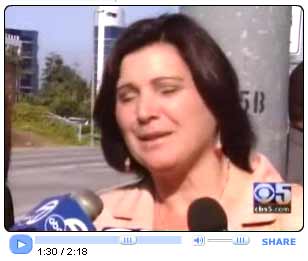
While the Mayor continues to use the incorrect number, the City of Santa Clara is beginning to agree with our estimates.
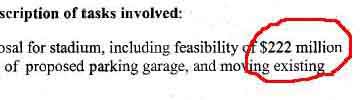
Buried in a report on the implementation plan and timeline for the "City of Santa Clara Principles & Priorities for 2007-09", which will be presented to the City Council tomorrow, is the City’s estimate of the requested subsidy.
$222,000,000
If you don’t want to do the math, that’s $62,000,000 — or about 39% — more than $160,000,000. This revised estimate of the subsidy includes the projected costs of both moving the electrical substation and the construction of a parking garage on the site, two items that were not included in the 49ers' $853,000,000 construction budget.
The new estimate still doesn't include the value of the land, but at least this number is closer to the true cost of the requested subsidy.
Pocket change, right?
You can view the report yourself from the city's own website:
http://cityclerkdatabase.ci.santa-clara.ca.us/wx/pubhtml/pubhtml/3009.html
It’s the report under Agenda Item 5F - Special Order of Business. The $222,000,000 is on page 15 of the report. Click on the image below for a PDF of the relevant page.
Once again, the City’s staff and consultants have provided a much-needed impartial analysis of this proposal, and we appreciate their hard work.
Of course, that amount doesn’t cover all the actual and potential costs — things like additional infrastructure improvements, property tax breaks, and lost opportunity costs — but it does include all of assets requested by the 49ers in their proposal.
While the Mayor, certain members of the City Council, and the 49ers have continued to claim that the requested subsidy is a mere $160,000,000, we have insisted that all of the public assets need to be counted.
Here is a video of Mayor Mahan using the incorrect $160,000,000 subsidy request figure on CBS5 TV, as recently as June 19. It's at the 1 minute 27 second mark of the report:
While the Mayor continues to use the incorrect number, the City of Santa Clara is beginning to agree with our estimates.
Buried in a report on the implementation plan and timeline for the "City of Santa Clara Principles & Priorities for 2007-09", which will be presented to the City Council tomorrow, is the City’s estimate of the requested subsidy.
$222,000,000
If you don’t want to do the math, that’s $62,000,000 — or about 39% — more than $160,000,000. This revised estimate of the subsidy includes the projected costs of both moving the electrical substation and the construction of a parking garage on the site, two items that were not included in the 49ers' $853,000,000 construction budget.
The new estimate still doesn't include the value of the land, but at least this number is closer to the true cost of the requested subsidy.
Pocket change, right?
You can view the report yourself from the city's own website:
http://cityclerkdatabase.ci.santa-clara.ca.us/wx/pubhtml/pubhtml/3009.html
It’s the report under Agenda Item 5F - Special Order of Business. The $222,000,000 is on page 15 of the report. Click on the image below for a PDF of the relevant page.
Once again, the City’s staff and consultants have provided a much-needed impartial analysis of this proposal, and we appreciate their hard work.
Friday, July 13, 2007
Sources for Stadium Subsidy
It was quite a shock to read in yesterday's Mercury News (Theme-park owner willing to consider 49ers stadium ) that:
I kind of doubt we missed $100 million.1
To date, only two sources for this cash have been identified:
What's so doable about that?
1 -- We have a query in to City Staff to confirm all the details of the proposed funding sources, and will update you once we get a response.
We at StadiumFacts.org have been following this issue pretty closely. Without City Staff's capable services, we can not be completely on top of everything. Perhaps we missed a detail or two.Mahan said she's encouraged by how city officials and consultants have identified almost two-thirds of the $160 million that the city would need to contribute to help the team build the $854 million stadium.
"This is becoming more and more doable the more we get into it," she said.
I kind of doubt we missed $100 million.1
To date, only two sources for this cash have been identified:
- Issuing redevelopment bonds. This would raise $13.1 million. If the city were to reduce the amount of money invested in affordable housing, they could raise $45.3 million by issuing redevelopment bonds.
- Leasing out city-owned land. The 7.6 acres under consideration are worth about $20 million. By tying up most of the remaining city-owned land in a 99 year lease, the city could get $2 million per year. But the city needs the money now (stadium builders won't wait 30 years to be paid), so the city would have to get the renter to pre-pay the rent. Unfortunately, that would only get us something like the current value of the land -- $20 million.
What's so doable about that?
1 -- We have a query in to City Staff to confirm all the details of the proposed funding sources, and will update you once we get a response.
Wednesday, July 11, 2007
A fool's investment
Dave Zirin, a sportswriter who writes for the Nation, SLAM magazine, and the Los Angeles Times, among many other publications, has just written a new book — Welcome to the Terrordome: The Pain, Politics and Promise of Sports — in which he explores the intersections of professional sports and social justice in the world today.
He will be speaking at 7pm tonight [Wednesday, July 11] at Cody's Books in Berkeley. (Check the end of this post for more details about the reading. )

Not surprisingly, one of subjects he analyzes in this book is public funding for professional sports stadiums. He wrote about the same issue in an article for last Sunday's San Francisco Chronicle.
The entire article — Are stadiums worth the high price? — is worth reading, but here are a few highlights:
We've already seen evidence of those refined blackmail skills in Santa Clara. The headline alone — Santa Clara risks losing more than a 49ers stadium: 49ers HQ in play if deal collapses — neatly summarizes the start of a campaign to blackmail the city of Santa Clara into approving this enormous public subsidy for billionaires.
Of course, the fact that the San Francisco 49ers pay the City just $24,000 PER YEAR to lease the 11-acre property should be evidence that the City already provides a significant subsidy to this team. Judging by the numbers presented at Tuesday's City Council meeting, the City should be getting closer to $2,500,000 - $3,100,000 PER YEAR for that land — that's over 100 times more than we're currently getting.
Later in the article, Zirin includes part of a conversation he had with Jim Bouton, a former Major League Baseball All-Star and the author of the memoir Ball Four. Bouton's assessment is even more damning.
The talk starts at 7pm at:
Cody's Books
1730 Fourth Street
Berkeley, CA 94710
(510) 559-9500
Click here for the event page.
He will be speaking at 7pm tonight [Wednesday, July 11] at Cody's Books in Berkeley. (Check the end of this post for more details about the reading. )

Not surprisingly, one of subjects he analyzes in this book is public funding for professional sports stadiums. He wrote about the same issue in an article for last Sunday's San Francisco Chronicle.
The entire article — Are stadiums worth the high price? — is worth reading, but here are a few highlights:
Stadiums are sporting shrines to the dogma of trickle-down economics. In the past 10 years, more than $16 billion of the public's money has been spent for stadium construction and upkeep from coast to coast. Though some cities are beginning to resist paying the full tab, any kind of subsidy is a fool's investment, ending up being little more than monuments to corporate greed: $500 million welfare hotels for America's billionaires built with funds that could have been spent more wisely on just about anything else.
. . .
As Neil DeMause, co-author of the book "Field of Schemes" said to me, "The history of the stadium game is the story of how, by slowly refining their blackmail skills, sports owners learned how to turn their industry from one based on selling tickets to one based on extracting public subsidies. It's been a bit like watching a 4-year-old learn how to manipulate his parents into buying him the new toy that he saw on TV; the question now is how long it takes our elected officials to learn to say 'no.' " [emphasis mine]
We've already seen evidence of those refined blackmail skills in Santa Clara. The headline alone — Santa Clara risks losing more than a 49ers stadium: 49ers HQ in play if deal collapses — neatly summarizes the start of a campaign to blackmail the city of Santa Clara into approving this enormous public subsidy for billionaires.
Of course, the fact that the San Francisco 49ers pay the City just $24,000 PER YEAR to lease the 11-acre property should be evidence that the City already provides a significant subsidy to this team. Judging by the numbers presented at Tuesday's City Council meeting, the City should be getting closer to $2,500,000 - $3,100,000 PER YEAR for that land — that's over 100 times more than we're currently getting.
Later in the article, Zirin includes part of a conversation he had with Jim Bouton, a former Major League Baseball All-Star and the author of the memoir Ball Four. Bouton's assessment is even more damning.
It's such a misapplication of the public's money. . . .It's going to be seen historically as an awful folly, and it's starting to be seen that way now, but historically that will go down as one of the real crimes of American government, national and local, to allow the funneling of people's money directly into the pockets of a handful of very wealthy individuals who could build these stadiums on their own if it made financial sense. If they don't make financial sense, then they shouldn't be building them.
If I was a team owner today, asking for public money, I'd be ashamed of myself. Ashamed of myself. But we've gone beyond shame. There's no such thing as shame anymore. People aren't embarrassed to take -- to do these awful things.
Of course, we certainly haven't seen any evidence of shame among the San Francisco 49ers and their supporters.
I've asked Dave Zirin if he could add a Santa Clara stop on his current book tour, and he's hoping to schedule a visit later this fall. But if you'd like to hear him sooner, the trip to Berkeley will be well worth it.The talk starts at 7pm at:
Cody's Books
1730 Fourth Street
Berkeley, CA 94710
(510) 559-9500
Click here for the event page.
Tuesday, July 10, 2007
A fun-filled summer evening

Tonight's City Council meeting might not be quite as much fun as a trip to an amusement park, but it's likely to be a whole other kind of wild ride.
This evening, the City Council will consider two reports related to the proposal to provide nearly $300,000,000 in public assets to help build a stadium for the San Francisco 49ers.
What are the items on tonight's agenda?:
1. In April, the City Council authorized spending $200,000 on consultants to provide analysis of the proposal. At the meeting tonight, City staff will recommended that the City Council authorize spending an additional $115,000 for consulting services.
2. The City Council will review KMA's report on developing an additional 11 acres to the east and west of Centennial Boulevard along Stars and Stripes Drive for the potential purpose of raising money to pay for the stadium.
The agenda is available here:
http://cityclerkdatabase.ci.santa-clara.ca.us/wx/pubhtml/pubhtml/3009.html
You can open the specific reports on these two items from the online agenda.
What can you do?:
1. Attend the City Council meeting on TONIGHT at 7pm and speak out! Speakers will probably be limited to 2 minutes each.
2. Call the Santa Clara City Council at
(408) 615-2250
3. Write a Letter to:
Patricia M. Mahan, Mayor
City Hall
1500 Warburton Avenue
Santa Clara, CA 95050
4. Send an email to:
MayorandCouncil@ci.santa-clara.ca.us
5. Spread the word! Tell your neighbors and friends and encourage them to get involved!
Friday, June 22, 2007
A tale of two cities
A few weeks ago, I analyzed the numbers from a Mercury News article Running 49ers stadium a costly pitfall. In my post A Costly Pitfall, I provided one crucial number that was missing from the initial article — the PER CAPITA cost of the subsidy.
Using just the numbers provided by the Mercury News, Santa Clara's subsidy of $180 million (the Mercury News did not include land value or the parking garage in their total), the PER RESIDENT subsidy of $1,651 was more than THREE TIMES that of the next closest project.
But the story doesn't end there.
Because I relied on the numbers in the Mercury News article, I calculated that the per resident cost of the new stadium for the Arizona Cardinals was $210 per resident.
That number is not exactly right for a few reasons.
First, the stadium is actually located in a suburb of Phoenix — Glendale, Arizona. The population of Glendale is approximately 258,677.
Second, the Mercury News article indicated that the public subsidy for this $455.7 million project was $310 million, but they didn't really break down either of these numbers.
The $455.7 million includes ALL costs related to the construction — including both land acquisition and site improvements. If these costs were added to the current San Francisco 49ers proposal, the total would be just shy of $1 BILLION [about $981 million to be more exact.]
Moreover, the city of Glendale's share of the $310 million subsidy was $9.9 million.
Yes, you read that right. Glendale spent $9.9 million on the project, for a per resident subsidy of about $38.
So where did they get the remaining $300.4 million of public money?
The rest of the subsidy came from the Arizona Sports and Tourism Authority [ASTA], a municipal organization created by the Arizona State Legislature to promote sports and tourism in Maricopa County, the county in which Phoenix and its suburbs are located. The funds for ASTA contribution came from a voter-approved county-wide tax on hotels and rental cars.
[To be clear, I'm not in favor of new taxes, especially to subsidize facilities for privately-held corporations, but the current claim that Santa Clara can provide $180 million in cash with no new taxes and no impact to the general fund or utility ratepayers is wrong. The money has to come from somewhere, and it WILL have an impact either directly or indirectly.]
Sadly, however, the unfavorable comparisons don't end with $38 vs $2,600.
You see, the stadium in Glendale was built with a special field that rolls out so that the stadium can be used for multiple purposes. It also has a retractable roof, again making it suitable for a variety of uses.
And it is.
From August 4, 2006 through January 8, 2007, it hosted events on 110 of the 157 days — about 70% utilization as compared to less than 10% using the most optimistic numbers in the current San Francisco 49ers proposal.
Maybe these numbers will help Santa Clara realize that it's time to do a bit of comparison shopping — and if we still decide to buy, maybe we can get a few friends, like Santa Clara County, to chip in on this purchase.
After all, if the claimed benefits are regional, then the costs should be shared by the region. Glendale didn't shoulder the cost for all of Maricopa County, and the City of Santa Clara cannot and should not assume the entire public expense and risk for this stadium.
Using just the numbers provided by the Mercury News, Santa Clara's subsidy of $180 million (the Mercury News did not include land value or the parking garage in their total), the PER RESIDENT subsidy of $1,651 was more than THREE TIMES that of the next closest project.
But the story doesn't end there.
Because I relied on the numbers in the Mercury News article, I calculated that the per resident cost of the new stadium for the Arizona Cardinals was $210 per resident.
That number is not exactly right for a few reasons.
First, the stadium is actually located in a suburb of Phoenix — Glendale, Arizona. The population of Glendale is approximately 258,677.
Second, the Mercury News article indicated that the public subsidy for this $455.7 million project was $310 million, but they didn't really break down either of these numbers.
The $455.7 million includes ALL costs related to the construction — including both land acquisition and site improvements. If these costs were added to the current San Francisco 49ers proposal, the total would be just shy of $1 BILLION [about $981 million to be more exact.]
Moreover, the city of Glendale's share of the $310 million subsidy was $9.9 million.
Yes, you read that right. Glendale spent $9.9 million on the project, for a per resident subsidy of about $38.
So where did they get the remaining $300.4 million of public money?
The rest of the subsidy came from the Arizona Sports and Tourism Authority [ASTA], a municipal organization created by the Arizona State Legislature to promote sports and tourism in Maricopa County, the county in which Phoenix and its suburbs are located. The funds for ASTA contribution came from a voter-approved county-wide tax on hotels and rental cars.
[To be clear, I'm not in favor of new taxes, especially to subsidize facilities for privately-held corporations, but the current claim that Santa Clara can provide $180 million in cash with no new taxes and no impact to the general fund or utility ratepayers is wrong. The money has to come from somewhere, and it WILL have an impact either directly or indirectly.]
Sadly, however, the unfavorable comparisons don't end with $38 vs $2,600.
You see, the stadium in Glendale was built with a special field that rolls out so that the stadium can be used for multiple purposes. It also has a retractable roof, again making it suitable for a variety of uses.
And it is.
From August 4, 2006 through January 8, 2007, it hosted events on 110 of the 157 days — about 70% utilization as compared to less than 10% using the most optimistic numbers in the current San Francisco 49ers proposal.
Maybe these numbers will help Santa Clara realize that it's time to do a bit of comparison shopping — and if we still decide to buy, maybe we can get a few friends, like Santa Clara County, to chip in on this purchase.
After all, if the claimed benefits are regional, then the costs should be shared by the region. Glendale didn't shoulder the cost for all of Maricopa County, and the City of Santa Clara cannot and should not assume the entire public expense and risk for this stadium.
Wednesday, June 20, 2007
The Santa Clara Way?
Today's San Jose Mercury News has a couple of brief articles—including Santa Clara mayor touts proposed 49ers site to NFL officials and 49ers see and are seen—on this week's visit from several NFL executives who toured the proposed stadium sites in both San Francisco and Santa Clara.
Is the NFL doing a little comparison shopping?
Why do the NFL executives care?
Well, the Yorks are counting on a loan from the NFL to cover at least part of their proposed contribution to the construction costs, so the NFL executives (unlike the City of Santa Clara, apparently) want to explore their options.
And what did Santa Clara's mayor Patricia Mahan have to say about the comparison shopping?
Oh really?
I guess I missed that change to the city's Code of Ethics and Values. The part where they apparently replaced "I convey the City's care for and commitment to its citizens" with "I convey the City's care for and commitment to the San Francisco 49ers and its fans."
That kind of service makes me wish I'd found a way to donate $1,000 to the mayor's campaign.
Certainly the mayors of both cities are treating this like a competition. Gavin Newsom, hardly a non-partisan in this issue, said
(I happen to agree with him on this point, but he's not really trying to offer objective advice to a fellow mayor.)
Santa Clara's mayor, in a burst of truthiness, countered Newsom's claim.
If he did, Madam Mayor, he apparently would NOT get the facts. The total city contribution requested so far under the current proposal is $180 million in cash for construction and site improvements (moving the electrical substation) PLUS $117 million in land and other property and assets. This does not include debt service payments or additional land for development.
As we've discussed before, $297 million is almost Real Money.
But if Santa Clara's new mission is to serve the 49ers, I guess it's all do-able. No need to wait for the completion of the feasibility studies.
Is this the new Santa Clara Way?
Is the NFL doing a little comparison shopping?
Why do the NFL executives care?
Well, the Yorks are counting on a loan from the NFL to cover at least part of their proposed contribution to the construction costs, so the NFL executives (unlike the City of Santa Clara, apparently) want to explore their options.
And what did Santa Clara's mayor Patricia Mahan have to say about the comparison shopping?
"This site, we believe, would give the fans a great game-day experience, and that's what it's all about: doing what's best for the 49ers and doing what's best for the fans."
Oh really?
I guess I missed that change to the city's Code of Ethics and Values. The part where they apparently replaced "I convey the City's care for and commitment to its citizens" with "I convey the City's care for and commitment to the San Francisco 49ers and its fans."
That kind of service makes me wish I'd found a way to donate $1,000 to the mayor's campaign.
Certainly the mayors of both cities are treating this like a competition. Gavin Newsom, hardly a non-partisan in this issue, said
"Any city that wants to put $200 million up, I can assure you the worst investment you can make is an NFL stadium."
(I happen to agree with him on this point, but he's not really trying to offer objective advice to a fellow mayor.)
Santa Clara's mayor, in a burst of truthiness, countered Newsom's claim.
"Actually, it's not $200 million, it's $160 million. I would hope that if Mr. Newsom wanted some facts, that he would give me a call."
If he did, Madam Mayor, he apparently would NOT get the facts. The total city contribution requested so far under the current proposal is $180 million in cash for construction and site improvements (moving the electrical substation) PLUS $117 million in land and other property and assets. This does not include debt service payments or additional land for development.
As we've discussed before, $297 million is almost Real Money.
But if Santa Clara's new mission is to serve the 49ers, I guess it's all do-able. No need to wait for the completion of the feasibility studies.
Is this the new Santa Clara Way?
Thursday, June 7, 2007
Return on Investment
The 49ers have described this stadium as a partnership where the City joins them in an investment. Now that the proposal has been taken apart by the City's own consultants, let's look at the investment at a back-of-the-napkin level. After all, many Silicon Valley start-ups began similarly in-depth.
The City is being asked to put in $160M of cash, $60M worth of land, $47M to build a parking garage, and $20M to $30M to move a power substation that's in the way. That's $297 million of capital that we are going to tie up.
So what kind of return are we getting out of this investment? How does $650K a year sound? (KMA report, page 3, 2nd paragraph.) That's 0.2% return on investment!
Compare this to some other investments:
Councilmember Kevin Moore says the stadium sounds like "an absolute winner." Maybe. On the Planet Mongo. Not here.
The City is being asked to put in $160M of cash, $60M worth of land, $47M to build a parking garage, and $20M to $30M to move a power substation that's in the way. That's $297 million of capital that we are going to tie up.
So what kind of return are we getting out of this investment? How does $650K a year sound? (KMA report, page 3, 2nd paragraph.) That's 0.2% return on investment!
Compare this to some other investments:
| 12-month CD | 5.05% |
| Mutual fund, indexed to S&P 500, 5 year average | 8.23% |
| San Jose real estate (median home price, 2000-2005 average) | 12.6% |
Councilmember Kevin Moore says the stadium sounds like "an absolute winner." Maybe. On the Planet Mongo. Not here.
Tuesday, May 29, 2007
More Real Money
In my post Real Money several weeks ago, I outlined the value of some of the assets that the San Francisco 49ers are asking Santa Clara to contribute to the proposed stadium. The total then? $297 million in cash, land, and other property.
As I noted at the time, this figure does not include the cost for replacing parking space for Great America — parking space that the city is required to provide as part of its agreement with the park and that will be lost if the stadium project moves forward.
The plans for providing that replacement parking will be one of the subjects of the City Council meeting tonight, Tuesday May 29. The meeting starts at 7:00 P.M. in the City Council Chambers, 1500 Warburton Avenue. If you can't attend in person, you can watch from the comfort of you own home on Channel 15!
I hope you will attend (or watch) and learn more about what the real costs of this project would be for the residents of Santa Clara.
As I noted at the time, this figure does not include the cost for replacing parking space for Great America — parking space that the city is required to provide as part of its agreement with the park and that will be lost if the stadium project moves forward.
The plans for providing that replacement parking will be one of the subjects of the City Council meeting tonight, Tuesday May 29. The meeting starts at 7:00 P.M. in the City Council Chambers, 1500 Warburton Avenue. If you can't attend in person, you can watch from the comfort of you own home on Channel 15!
I hope you will attend (or watch) and learn more about what the real costs of this project would be for the residents of Santa Clara.
Tuesday, May 22, 2007
A Costly Pitfall
In yesterday's Mercury News, reporter Mike Swift examined the costs not just of building a stadium but also of operating it for the next 30 years. As he notes in his article Running 49ers stadium a costly pitfall . . .
Of particular interest to the residents of Santa Clara is the fact that while the 49ers have stated that they will pay for construction cost overruns, they have not agreed to pay operating expense deficits.
As we pointed out last week, their answer was simply that the Stadium Authority could “push back the cost on the tenants," which might seem reasonable until you consider that the stadium’s main (and perhaps only) tenant will be the San Francisco 49ers, who are asking, of course, for a long-term fixed-rate lease. Moreover, under the current plan, the team won’t even be covering its own game day costs.
The San Francisco 49ers also pull a neat slight-of-hand trick in this article. In their presentation to the Santa Clara City Council, they counted all of the construction money raised by the proposed city-operated Stadium Authority alongside the team's contribution in order to make it look like the city was only contributing 18.7% of the construction costs. [It's on page 12 of their presentation.]
But in yesterday's article, the 49ers CFO refers to the Stadium Authority contributions from the sale of naming rights as "the public side" of the funding. Funny how that classification changes depending upon what they need it to be.
Mike also presented some interesting comparisons among different recent football stadium projects. While at first glance it may look like Santa Clara is getting a better deal than is typical, the chart accompanying the article left out one important calculation — the PER RESIDENT cost.
Using the numbers in the chart, which don't include the value of additional property or other contributions, here is the breakdown of these deals in terms of the construction cost cash subsidy PER RESIDENT:
I think these numbers provide an important perspective on the size of the subsidy relative to the size of the community. (And I have to say that the Santa Clara number makes me nauseous, but that's just me.)
So if the City Council asked you how they should invest $1,651 on your behalf, what would you tell them?
When an NFL team asks government officials to help build a stadium, public debate frequently focuses on the construction costs. But sometimes, the bills are only beginning when the gates swing open.
Of particular interest to the residents of Santa Clara is the fact that while the 49ers have stated that they will pay for construction cost overruns, they have not agreed to pay operating expense deficits.
As we pointed out last week, their answer was simply that the Stadium Authority could “push back the cost on the tenants," which might seem reasonable until you consider that the stadium’s main (and perhaps only) tenant will be the San Francisco 49ers, who are asking, of course, for a long-term fixed-rate lease. Moreover, under the current plan, the team won’t even be covering its own game day costs.
The San Francisco 49ers also pull a neat slight-of-hand trick in this article. In their presentation to the Santa Clara City Council, they counted all of the construction money raised by the proposed city-operated Stadium Authority alongside the team's contribution in order to make it look like the city was only contributing 18.7% of the construction costs. [It's on page 12 of their presentation.]
But in yesterday's article, the 49ers CFO refers to the Stadium Authority contributions from the sale of naming rights as "the public side" of the funding. Funny how that classification changes depending upon what they need it to be.
Mike also presented some interesting comparisons among different recent football stadium projects. While at first glance it may look like Santa Clara is getting a better deal than is typical, the chart accompanying the article left out one important calculation — the PER RESIDENT cost.
Using the numbers in the chart, which don't include the value of additional property or other contributions, here is the breakdown of these deals in terms of the construction cost cash subsidy PER RESIDENT:
- Phoenix - $310 million - $210 per resident
- Seattle - $300 million - $518 per resident (city) or $92 (metro area)
- Dallas - $325 million - $260 per resident (city) or $54 (metro area)
- Santa Clara - $180 million - $1,651 per resident
I think these numbers provide an important perspective on the size of the subsidy relative to the size of the community. (And I have to say that the Santa Clara number makes me nauseous, but that's just me.)
So if the City Council asked you how they should invest $1,651 on your behalf, what would you tell them?
Subscribe to:
Posts (Atom)