There was a spirited crowd at Peterson Middle School on Wednesday night, eager to learn more about the most important City-wide initiative of the century -- Measure J, the Stadium Subsidy.
And, learn they did. Kolstad & Kennedy covered topics as varied as the technical minutia of redevelopment law, school financing, game-day public safety measures and the stadium's potential impact on our perilously overdrawn City budget.
They even discussed campaign finance reform:
While we were not able to capture every moment of the evening's proceedings, we have posted as much as we could on youtube, where you will find discussions on:
Sit back, grab a bag of popcorn & let the good times roll!
Showing posts with label utilization. Show all posts
Showing posts with label utilization. Show all posts
Sunday, May 9, 2010


Wednesday, November 7, 2007
White elephant

white elephant, n. 1. an Indian elephant of a pale color that is sometimes venerated in India, Sri Lanka, Thailand, and [Burma]; 2a. a property requiring much care and expense and yielding little profit; 2b. an object no longer of value to its owner but of value to others; 2c. something of little or no value. Merriam-Webster Online.White elephants are rare albinos that are highly prized by the kings of Thailand, Burma and other Asian countries. Thanks to their special status, they don't have to work as beasts of burden, like their normally pigmented cousins. However, just like regular elephants, they are large animals with large appetites. Therefore giving someone a white elephant is considered both a gift and a curse.
According to Mahidol University (Thailand,) because of ...
... the inordinate cost of maintaining a white elephant ... [such a] gift could easily induce bankruptcy if not also accompanied by a grant of land. So singular an honor as a white elephant could obviously not be refused, but without land it was subtly barbed -- an indirect criticism which apparently cooled the heels of excessively ambitious minions.So instead of "Oh boy, we are going to own a billion-dollar stadium, and it will only cost us a couple of hundred millions," maybe we should be asking "Why do we have to pay $222,000,000 to scoop up elephant droppings?"
Friday, June 22, 2007
A tale of two cities
A few weeks ago, I analyzed the numbers from a Mercury News article Running 49ers stadium a costly pitfall. In my post A Costly Pitfall, I provided one crucial number that was missing from the initial article — the PER CAPITA cost of the subsidy.
Using just the numbers provided by the Mercury News, Santa Clara's subsidy of $180 million (the Mercury News did not include land value or the parking garage in their total), the PER RESIDENT subsidy of $1,651 was more than THREE TIMES that of the next closest project.
But the story doesn't end there.
Because I relied on the numbers in the Mercury News article, I calculated that the per resident cost of the new stadium for the Arizona Cardinals was $210 per resident.
That number is not exactly right for a few reasons.
First, the stadium is actually located in a suburb of Phoenix — Glendale, Arizona. The population of Glendale is approximately 258,677.
Second, the Mercury News article indicated that the public subsidy for this $455.7 million project was $310 million, but they didn't really break down either of these numbers.
The $455.7 million includes ALL costs related to the construction — including both land acquisition and site improvements. If these costs were added to the current San Francisco 49ers proposal, the total would be just shy of $1 BILLION [about $981 million to be more exact.]
Moreover, the city of Glendale's share of the $310 million subsidy was $9.9 million.
Yes, you read that right. Glendale spent $9.9 million on the project, for a per resident subsidy of about $38.
So where did they get the remaining $300.4 million of public money?
The rest of the subsidy came from the Arizona Sports and Tourism Authority [ASTA], a municipal organization created by the Arizona State Legislature to promote sports and tourism in Maricopa County, the county in which Phoenix and its suburbs are located. The funds for ASTA contribution came from a voter-approved county-wide tax on hotels and rental cars.
[To be clear, I'm not in favor of new taxes, especially to subsidize facilities for privately-held corporations, but the current claim that Santa Clara can provide $180 million in cash with no new taxes and no impact to the general fund or utility ratepayers is wrong. The money has to come from somewhere, and it WILL have an impact either directly or indirectly.]
Sadly, however, the unfavorable comparisons don't end with $38 vs $2,600.
You see, the stadium in Glendale was built with a special field that rolls out so that the stadium can be used for multiple purposes. It also has a retractable roof, again making it suitable for a variety of uses.
And it is.
From August 4, 2006 through January 8, 2007, it hosted events on 110 of the 157 days — about 70% utilization as compared to less than 10% using the most optimistic numbers in the current San Francisco 49ers proposal.
Maybe these numbers will help Santa Clara realize that it's time to do a bit of comparison shopping — and if we still decide to buy, maybe we can get a few friends, like Santa Clara County, to chip in on this purchase.
After all, if the claimed benefits are regional, then the costs should be shared by the region. Glendale didn't shoulder the cost for all of Maricopa County, and the City of Santa Clara cannot and should not assume the entire public expense and risk for this stadium.
Using just the numbers provided by the Mercury News, Santa Clara's subsidy of $180 million (the Mercury News did not include land value or the parking garage in their total), the PER RESIDENT subsidy of $1,651 was more than THREE TIMES that of the next closest project.
But the story doesn't end there.
Because I relied on the numbers in the Mercury News article, I calculated that the per resident cost of the new stadium for the Arizona Cardinals was $210 per resident.
That number is not exactly right for a few reasons.
First, the stadium is actually located in a suburb of Phoenix — Glendale, Arizona. The population of Glendale is approximately 258,677.
Second, the Mercury News article indicated that the public subsidy for this $455.7 million project was $310 million, but they didn't really break down either of these numbers.
The $455.7 million includes ALL costs related to the construction — including both land acquisition and site improvements. If these costs were added to the current San Francisco 49ers proposal, the total would be just shy of $1 BILLION [about $981 million to be more exact.]
Moreover, the city of Glendale's share of the $310 million subsidy was $9.9 million.
Yes, you read that right. Glendale spent $9.9 million on the project, for a per resident subsidy of about $38.
So where did they get the remaining $300.4 million of public money?
The rest of the subsidy came from the Arizona Sports and Tourism Authority [ASTA], a municipal organization created by the Arizona State Legislature to promote sports and tourism in Maricopa County, the county in which Phoenix and its suburbs are located. The funds for ASTA contribution came from a voter-approved county-wide tax on hotels and rental cars.
[To be clear, I'm not in favor of new taxes, especially to subsidize facilities for privately-held corporations, but the current claim that Santa Clara can provide $180 million in cash with no new taxes and no impact to the general fund or utility ratepayers is wrong. The money has to come from somewhere, and it WILL have an impact either directly or indirectly.]
Sadly, however, the unfavorable comparisons don't end with $38 vs $2,600.
You see, the stadium in Glendale was built with a special field that rolls out so that the stadium can be used for multiple purposes. It also has a retractable roof, again making it suitable for a variety of uses.
And it is.
From August 4, 2006 through January 8, 2007, it hosted events on 110 of the 157 days — about 70% utilization as compared to less than 10% using the most optimistic numbers in the current San Francisco 49ers proposal.
Maybe these numbers will help Santa Clara realize that it's time to do a bit of comparison shopping — and if we still decide to buy, maybe we can get a few friends, like Santa Clara County, to chip in on this purchase.
After all, if the claimed benefits are regional, then the costs should be shared by the region. Glendale didn't shoulder the cost for all of Maricopa County, and the City of Santa Clara cannot and should not assume the entire public expense and risk for this stadium.
Friday, June 1, 2007
"Imagination and a bit of daring"

Yesterday the San Jose Mercury News published an interesting article by Alan Hess about "Why Santana Row succeeds."
Why is this article relevant to a website about the proposed stadium?
Well, at least one City Council Member has emphasized the desire to create an entertainment district in the area of Santa Clara where the stadium is planned. It is useful, therefore, to think about what makes an entertainment area successful.
Santana Row is clearly an example of such a district.
As Hess notes,
Residents of the townhomes on the upper levels of Santana Row's blocks can look from their windows and balconies and see something pretty much like real life on the streets below: fitness freaks on their way to the health club at dawn, mothers with strollers sitting in the parks in the mid-morning sun, business people business-lunching at sidewalk cafes at noon, shoppers cruising in and out of stores all day long, and San Jose residents of different sorts arriving to dine, drink, shop, buy a book, watch movies or dance until late at night.
Have you tried to go there on a Friday or Saturday night? It may be hard to find a parking spot, but once you get there, there's lively street life. On other days, there are free concerts, a farmers' market, open-air movies, and other events and activities.
It may have its origins in mall development, but as Hess writes
Santana Row realizes that we want to be with our fellow humans for reasons other than selling or being sold to. We dine at sidewalk cafes to enjoy good food and good friends, not to increase the stock price of an agribusiness corporation. We want to be near the action. We want to see what other people are doing - and we want other people to know what we are doing, wearing and saying.
A stadium used less than 30 days a year, on the other hand, would not enable the kind of daily interaction needed to create a vibrant social scene.
And one more important point — Santana Row was built through private financing. As Hess explains,
So, "with imagination and a bit of daring" what could Santa Clara do to create an entertainment district that would succeed like Santana Row has?Ironically it's everything that the publicly funded San Jose Redevelopment Agency has been trying to achieve in downtown San Jose for 20 years. The privately financed Santana Row made it happen first.
True, Santana Row is much smaller than downtown San Jose. The real difference, though, is the design.
Sunday, May 20, 2007
The Santa Clara Way
City Council member Dominic Caserta hit the nail on the head when he said,
The decision on building a stadium in Santa Clara — and the larger issue of how to develop the entertainment district — must shun politics, and be made in adherence to our principles of fiscal prudence, consensus building and democracy.
Let's examine these three important principles in detail.
Fiscal Prudence.
I used the 49ers waterfall financial model (slides 15 - 17 of 49ers Proposal) to see what it would take for Santa Clara to break even after 30 years. The Stadium Authority would have to net over $15M annually in non-49ers events just to break even. By the 49ers' own calculations, this would be almost impossible.
It was really interesting to see how this profits the 49ers. In addition to their football profits, the 49ers would get a cut of non-49ers events amounting to over $45M over the life of the stadium.
Wow. The stadium is looking pretty good for the 49ers... Their rent goes down. They get a high tech ballpark & guaranteed capital improvements — increasing their market value significantly. Plus, they make an additional $45M off the backs of Santa Clara — approximately $450 per person.
Sorry Sally, no new bicycle for you, Jed York needs a new yacht.
Consensus building.
A recent CBS5 poll showed that 55% of Santa Clara residents oppose building a new stadium if it meant using public funds. Rather than forcing through a stadium proposal that has so little public support, the city must build consensus on how to best develop the entertainment district.
Building consensus requires effort to develop a proposal that will be an asset to the community. It must bring in a diversity of venues that will ensure high utilization, attract a broad cross-section of the community and keep a large percentage of revenues in the city.
The 49ers proposal achieves none of these goals. By all estimates, the stadium will be utilized between 10 and 30 days out of the year. The remaining 335 days will leave the district with a dark hole that could gobble up every man, woman and child in Milpitas, and still have room for dessert.
Big empty places are scary. Only the foolhardy, the drunks and shady characters will find this behemoth an attraction.
Democracy vs. Politics.
The 49ers have politicized this discussion with their paid consultants and slick sales pitches to City Council and to the community.
Stop the politics. Insist on putting this critical issue before the people on a general election ballot.
We in Santa Clara do things very well. We're fiscally prudent and we make decisions based on consensus building and principles, not politics.
The decision on building a stadium in Santa Clara — and the larger issue of how to develop the entertainment district — must shun politics, and be made in adherence to our principles of fiscal prudence, consensus building and democracy.
Let's examine these three important principles in detail.
Fiscal Prudence.
I used the 49ers waterfall financial model (slides 15 - 17 of 49ers Proposal) to see what it would take for Santa Clara to break even after 30 years. The Stadium Authority would have to net over $15M annually in non-49ers events just to break even. By the 49ers' own calculations, this would be almost impossible.
It was really interesting to see how this profits the 49ers. In addition to their football profits, the 49ers would get a cut of non-49ers events amounting to over $45M over the life of the stadium.
Wow. The stadium is looking pretty good for the 49ers... Their rent goes down. They get a high tech ballpark & guaranteed capital improvements — increasing their market value significantly. Plus, they make an additional $45M off the backs of Santa Clara — approximately $450 per person.
Sorry Sally, no new bicycle for you, Jed York needs a new yacht.
Consensus building.
A recent CBS5 poll showed that 55% of Santa Clara residents oppose building a new stadium if it meant using public funds. Rather than forcing through a stadium proposal that has so little public support, the city must build consensus on how to best develop the entertainment district.
Building consensus requires effort to develop a proposal that will be an asset to the community. It must bring in a diversity of venues that will ensure high utilization, attract a broad cross-section of the community and keep a large percentage of revenues in the city.
The 49ers proposal achieves none of these goals. By all estimates, the stadium will be utilized between 10 and 30 days out of the year. The remaining 335 days will leave the district with a dark hole that could gobble up every man, woman and child in Milpitas, and still have room for dessert.
Big empty places are scary. Only the foolhardy, the drunks and shady characters will find this behemoth an attraction.
Democracy vs. Politics.
The 49ers have politicized this discussion with their paid consultants and slick sales pitches to City Council and to the community.
Stop the politics. Insist on putting this critical issue before the people on a general election ballot.
Sunday, May 6, 2007
Better cross your legs...
Would you spend almost 3000 buckaroonies to remodel a bathroom that you can only use once every 10 days? And if you tried to use it more often, the toilet would back up?
I didn't think so.
Yet that's exactly what the proposed 49ers stadium would be like. It would cost close to $3000 for every man, woman, and child in Santa Clara. By the most optimistic estimates (the 49ers' of course) the stadium would see action about 30 days a year (10 home games, plus 20 "special events.")
"A couple more days if we make the playoffs," says Lisa Lang, the 49ers' VP of communications.
So the only way to make this investment pay off is to increase the number of events. But wait! If you think the neighbors are up in arms about traffic etc now, wait until we try to put on even more events! There goes that overflowing toilet...
So to recap, 30 days out of 365 days a year, that's not even 10% utilization, folks!
Compare this to other investments we can make:
What does that utilization look like?
The moral of the story? If we're going to invest in something big, let's invest in something that will get a lot of use.
PS. Also, don't forget, that's $2900 per head, so for the average Santa Clara household with 2.58 :-) persons, that's just about $7500. That ought to pay for marble vanities and a heated toilet seat.
I didn't think so.
Yet that's exactly what the proposed 49ers stadium would be like. It would cost close to $3000 for every man, woman, and child in Santa Clara. By the most optimistic estimates (the 49ers' of course) the stadium would see action about 30 days a year (10 home games, plus 20 "special events.")
"A couple more days if we make the playoffs," says Lisa Lang, the 49ers' VP of communications.
So the only way to make this investment pay off is to increase the number of events. But wait! If you think the neighbors are up in arms about traffic etc now, wait until we try to put on even more events! There goes that overflowing toilet...
So to recap, 30 days out of 365 days a year, that's not even 10% utilization, folks!
Compare this to other investments we can make:
- A school would resound with the pitty-patter of little feet at least 9 months out of the year, or about 53% utilization. (We don't count weekends, 'cause the little tykes ought to have time off for Little League, etc.)
- A typical Silicon Valley office building would be in use 5-6 days a week (7 if it's Yahoo's -- they gotta catch up to Google.) Minus a couple of weeks off for Diwali and Chinese New Year, etc, that's still easily 65% utilization.
- A library like the cool new one on Homestead can be open 7 days a week -- if the city hasn't already blown its wad subsidizing billionaires.
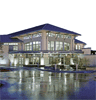
What does that utilization look like?
| Stadium: 10% | School: 53% |
 |  |
| Office: 65% | Library: 100% |
 |  |
The moral of the story? If we're going to invest in something big, let's invest in something that will get a lot of use.
PS. Also, don't forget, that's $2900 per head, so for the average Santa Clara household with 2.58 :-) persons, that's just about $7500. That ought to pay for marble vanities and a heated toilet seat.
The Dark Stadium
Santa Clara City Council says they want to invest in the "entertainment district" on the north side of town. But in fact, they are looking to burn over $2900 per SC resident to subsidize a stadium that -- best case -- will be completely dark 330 days a year. That's a black hole the size of Milpitas (population: 63,000, vs. Proposed Stadium Occupancy: 68,500), most suited to attracting undesirable elements looking for a shadow in which to do an illicit deal.
If Santa Clara City Council really wants to make an investment in the entertainment district, shouldn't they actively solicit other proposals? And if they want to make this a sound investment, shouldn't they consider a well-diversified portfolio of investments, rather than a single all-or-nothing boat anchor of a deal?
And if City Council wants this investment to help sustain the city as a great place to live, shouldn't they try to augment the current big-box entertainment venues with more human scale developments, encouraging people to get out of their cars and spend all their entertainment dollars in the district -- rather than only within the fortress of the "Naming Rights" Stadium?
Santa Clara City Council need look no further than Mountain View's Castro St., Sunnyvale's Murphy St., Santa Cruz's Pacific Avenue or even Milpitas' Great Mall to see great examples of diversified entertainment districts that enhance the community without putting all the City's eggs in one basket.
If Santa Clara City Council really wants to make an investment in the entertainment district, shouldn't they actively solicit other proposals? And if they want to make this a sound investment, shouldn't they consider a well-diversified portfolio of investments, rather than a single all-or-nothing boat anchor of a deal?
And if City Council wants this investment to help sustain the city as a great place to live, shouldn't they try to augment the current big-box entertainment venues with more human scale developments, encouraging people to get out of their cars and spend all their entertainment dollars in the district -- rather than only within the fortress of the "Naming Rights" Stadium?
Santa Clara City Council need look no further than Mountain View's Castro St., Sunnyvale's Murphy St., Santa Cruz's Pacific Avenue or even Milpitas' Great Mall to see great examples of diversified entertainment districts that enhance the community without putting all the City's eggs in one basket.
Subscribe to:
Posts (Atom)