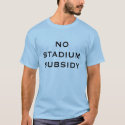
There was a spirited crowd at Peterson Middle School on Wednesday night, eager to learn more about the most important City-wide initiative of the century -- Measure J, the Stadium Subsidy.
And, learn they did. Kolstad & Kennedy covered topics as varied as the technical minutia of redevelopment law, school financing, game-day public safety measures and the stadium's potential impact on our perilously overdrawn City budget.
They even discussed campaign finance reform:
While we were not able to capture every moment of the evening's proceedings, we have posted as much as we could on youtube, where you will find discussions on:
Sit back, grab a bag of popcorn & let the good times roll!
Showing posts with label entertainment district. Show all posts
Showing posts with label entertainment district. Show all posts
Sunday, May 9, 2010


Saturday, October 20, 2007
"Pay no attention to that man behind the curtain."
Former Mayor Gillmor, the power behind the throne in Santa Clara politics, publicly excoriated Cedar Fair this week. The owner of Great America apparently committed a whipping offense when it raised objections to the proposed stadium. Cedar Fair was "acting in [its] narrow self-interest," according to Mr Gillmor.
Let's draw an analogy.
Imagine you are renting a nice little bungalow. One day the landlord just shows up, unannounced, with a casino operator. They proceed to discuss building a card club, right where your garage is.
Would you be upset? Of course you would. You might even oppose the deal. Is that "acting in [your] narrow self-interest?" Most people would say, no probably not. Certainly nobody could blame you for your objections.
So here's Cedar Fair. The owner-operator of the Great America theme park has been renting land from the City for years. They have a long term lease. They pay a fair rent*, which is more than their neighbor, the SF 49ers, can say.
Now this neighbor wants to build a stadium where Cedar Fair's parking lot is. Apparently nobody got their agreement in advance. Cedar Fair understandably doesn't think this is such a great idea. Nobody can blame them for that.
Or can they?
Mayor Gillmor thinks he can. But since when does a private business have to act in anybody's interest but their stockholders'? It sounds brutal, but that's capitalism, which Mr Gillmor surely knows a thing or two about.
If this episode says anything, it is that the 49ers stadium deal is on life support. Why else would the éminence grise himself have to come out from behind the scenes to stump for it? The simple fact is that the 49ers are demanding an exorbitant subsidy from Santa Clara taxpayers. Furthermore, they are so fixated on the feeding trough that they forget to say "Pardon me" to their neighbors.
In the words of City Manager Jennifer Sparacino, we Santa Clarans should strive to treat all parties "fairly and equally, without special favors."
--
* Cedar Fair pays the city "at least $5.3 million annually in rent" for the Great America property. For their training camp next door, the 49ers pay "about $24,000 a year - less than what it costs to rent some two-bedroom apartments nearby."
Let's draw an analogy.
Imagine you are renting a nice little bungalow. One day the landlord just shows up, unannounced, with a casino operator. They proceed to discuss building a card club, right where your garage is.
Would you be upset? Of course you would. You might even oppose the deal. Is that "acting in [your] narrow self-interest?" Most people would say, no probably not. Certainly nobody could blame you for your objections.
So here's Cedar Fair. The owner-operator of the Great America theme park has been renting land from the City for years. They have a long term lease. They pay a fair rent*, which is more than their neighbor, the SF 49ers, can say.
Now this neighbor wants to build a stadium where Cedar Fair's parking lot is. Apparently nobody got their agreement in advance. Cedar Fair understandably doesn't think this is such a great idea. Nobody can blame them for that.
Or can they?
Mayor Gillmor thinks he can. But since when does a private business have to act in anybody's interest but their stockholders'? It sounds brutal, but that's capitalism, which Mr Gillmor surely knows a thing or two about.
If this episode says anything, it is that the 49ers stadium deal is on life support. Why else would the éminence grise himself have to come out from behind the scenes to stump for it? The simple fact is that the 49ers are demanding an exorbitant subsidy from Santa Clara taxpayers. Furthermore, they are so fixated on the feeding trough that they forget to say "Pardon me" to their neighbors.
In the words of City Manager Jennifer Sparacino, we Santa Clarans should strive to treat all parties "fairly and equally, without special favors."
--
* Cedar Fair pays the city "at least $5.3 million annually in rent" for the Great America property. For their training camp next door, the 49ers pay "about $24,000 a year - less than what it costs to rent some two-bedroom apartments nearby."
Wednesday, October 10, 2007
One wild ride
Yesterday I wrote that the City Council should not spend any more money on studying the San Francisco 49ers' stadium subsidy request until the City had a signed agreement from Cedar Fair.
I didn't really expect the City Council to postpone this request for additional money, but today's press release from Cedar Fair — "Cedar Fair opposes proposed 49ers stadium" — is precisely the reason why the City of Santa Clara should have obtained a signed agreement with Cedar Fair before spending a dime of taxpayer money on studying the proposal.
Cedar Fair's opposition isn't a complete roadblock to the stadium proposal — in its press release, Cedar Fair states its willingness to "consider selling the remainder of its lease and all of its interest and assets to the City or 49ers for fair market value" — but its opposition completely changes the circumstances of the proposal. If the City Council still wants to move forward with this proposal, it needs to study the feasibility in light of these new conditions.
The San Francisco 49ers, however, were quick to provide an alternative plan — they'll just buy the theme park.
A couple of problems with this new proposal.
First, as Santa Clara's Deputy City Manager Carol McCarthy told the San Jose Mercury News "Any sale requires the city's approval and is contingent on having a class A theme-park operator . . . with proven financial ability to operate it."
So, to use a baseball metaphor, strike one.
Second, the San Francisco 49ers have asked the city for $222,000,000 in public assets plus 15 acres of land to build the stadium. If they don't have the money to build their own stadium, how can they afford a theme park? And if we the taxpayers are subsidizing their place of business, is our subsidy helping them to acquire more business assets? Should public money be used to help a wealthy team owner buy even more private assets?
Strike two.
Finally, in many of their presentations to city residents, the 49ers have tried to claim that they want the City to operate the stadium because they "are in the football business, not the stadium business." (My previous responses to that claim have been "our city isn't in the stadium business either" and "that's a little like Intel saying its not in the office building business." Intel certainly isn't in the office building business, but it didn't use that argument to try and convince the city to build an office for them.)
But if the 49ers don't want to be in the stadium business, why on earth are they considering a leap into the theme park business? Shouldn't they stick a little closer to their core competencies?
I'll call that strike three.
Is this latest theme park idea just a last-minute desperation strategy? Are the 49ers merely clinging to any shred of hope that this proposal is viable? Do the San Francisco 49ers need to keep up the image that the Santa Clara plan is viable in order to put pressure on San Francisco to complete its proposal? Once the San Francisco proposal is in place, will the 49ers still be talking about venturing into the theme park business?
Time will certainly tell, but until then, be sure your seat belt is fastened and keep your arms and legs inside the car at all times.
It looks like it's going to be a wild ride.
UPDATE:
According to Julie Patel's article in the Mercury News today — Niners eye new spot for possible stadium — there may be another option. The proposed stadium site would be moved to an overflow parking on the other side of San Tomas Creek. But if they used this site, the 49ers would need to resubmit all of their site plans and traffic analysis, and the City would have to develop a plan to replace the parking Cedar Fair would be losing.
So this is yet another reason the City Council should have received Great America's approval in writing before spending any money even studying this proposal. As Ms. Patel writes in her article: "Whatever happens, the shifting debate is bound to cost the city of Santa Clara more time and money, on top of the $500,000 approved to research a stadium."
I didn't really expect the City Council to postpone this request for additional money, but today's press release from Cedar Fair — "Cedar Fair opposes proposed 49ers stadium" — is precisely the reason why the City of Santa Clara should have obtained a signed agreement with Cedar Fair before spending a dime of taxpayer money on studying the proposal.
Cedar Fair's opposition isn't a complete roadblock to the stadium proposal — in its press release, Cedar Fair states its willingness to "consider selling the remainder of its lease and all of its interest and assets to the City or 49ers for fair market value" — but its opposition completely changes the circumstances of the proposal. If the City Council still wants to move forward with this proposal, it needs to study the feasibility in light of these new conditions.
The San Francisco 49ers, however, were quick to provide an alternative plan — they'll just buy the theme park.
A couple of problems with this new proposal.
First, as Santa Clara's Deputy City Manager Carol McCarthy told the San Jose Mercury News "Any sale requires the city's approval and is contingent on having a class A theme-park operator . . . with proven financial ability to operate it."
So, to use a baseball metaphor, strike one.
Second, the San Francisco 49ers have asked the city for $222,000,000 in public assets plus 15 acres of land to build the stadium. If they don't have the money to build their own stadium, how can they afford a theme park? And if we the taxpayers are subsidizing their place of business, is our subsidy helping them to acquire more business assets? Should public money be used to help a wealthy team owner buy even more private assets?
Strike two.
Finally, in many of their presentations to city residents, the 49ers have tried to claim that they want the City to operate the stadium because they "are in the football business, not the stadium business." (My previous responses to that claim have been "our city isn't in the stadium business either" and "that's a little like Intel saying its not in the office building business." Intel certainly isn't in the office building business, but it didn't use that argument to try and convince the city to build an office for them.)
But if the 49ers don't want to be in the stadium business, why on earth are they considering a leap into the theme park business? Shouldn't they stick a little closer to their core competencies?
I'll call that strike three.
Is this latest theme park idea just a last-minute desperation strategy? Are the 49ers merely clinging to any shred of hope that this proposal is viable? Do the San Francisco 49ers need to keep up the image that the Santa Clara plan is viable in order to put pressure on San Francisco to complete its proposal? Once the San Francisco proposal is in place, will the 49ers still be talking about venturing into the theme park business?
Time will certainly tell, but until then, be sure your seat belt is fastened and keep your arms and legs inside the car at all times.
It looks like it's going to be a wild ride.
UPDATE:
According to Julie Patel's article in the Mercury News today — Niners eye new spot for possible stadium — there may be another option. The proposed stadium site would be moved to an overflow parking on the other side of San Tomas Creek. But if they used this site, the 49ers would need to resubmit all of their site plans and traffic analysis, and the City would have to develop a plan to replace the parking Cedar Fair would be losing.
So this is yet another reason the City Council should have received Great America's approval in writing before spending any money even studying this proposal. As Ms. Patel writes in her article: "Whatever happens, the shifting debate is bound to cost the city of Santa Clara more time and money, on top of the $500,000 approved to research a stadium."
Friday, August 3, 2007
Remembering Bill Walsh
First, I’d like to express my condolences to Bill Walsh’s family, the
Friday, June 1, 2007
"Imagination and a bit of daring"

Yesterday the San Jose Mercury News published an interesting article by Alan Hess about "Why Santana Row succeeds."
Why is this article relevant to a website about the proposed stadium?
Well, at least one City Council Member has emphasized the desire to create an entertainment district in the area of Santa Clara where the stadium is planned. It is useful, therefore, to think about what makes an entertainment area successful.
Santana Row is clearly an example of such a district.
As Hess notes,
Residents of the townhomes on the upper levels of Santana Row's blocks can look from their windows and balconies and see something pretty much like real life on the streets below: fitness freaks on their way to the health club at dawn, mothers with strollers sitting in the parks in the mid-morning sun, business people business-lunching at sidewalk cafes at noon, shoppers cruising in and out of stores all day long, and San Jose residents of different sorts arriving to dine, drink, shop, buy a book, watch movies or dance until late at night.
Have you tried to go there on a Friday or Saturday night? It may be hard to find a parking spot, but once you get there, there's lively street life. On other days, there are free concerts, a farmers' market, open-air movies, and other events and activities.
It may have its origins in mall development, but as Hess writes
Santana Row realizes that we want to be with our fellow humans for reasons other than selling or being sold to. We dine at sidewalk cafes to enjoy good food and good friends, not to increase the stock price of an agribusiness corporation. We want to be near the action. We want to see what other people are doing - and we want other people to know what we are doing, wearing and saying.
A stadium used less than 30 days a year, on the other hand, would not enable the kind of daily interaction needed to create a vibrant social scene.
And one more important point — Santana Row was built through private financing. As Hess explains,
So, "with imagination and a bit of daring" what could Santa Clara do to create an entertainment district that would succeed like Santana Row has?Ironically it's everything that the publicly funded San Jose Redevelopment Agency has been trying to achieve in downtown San Jose for 20 years. The privately financed Santana Row made it happen first.
True, Santana Row is much smaller than downtown San Jose. The real difference, though, is the design.
Wednesday, May 9, 2007
"One heck of an anchor"
There are several ways to look at the word "anchor."
When Santa Clara Councilman Kevin Moore described the proposed San Francisco 49ers' stadium as "one heck of an anchor" in building "an incredible entertainment district," he was probably thinking about an anchor as "a source of security or stability."
When I nicknamed my new sofa bed "the anchor" (many, many years ago), I was thinking of it in terms of something that would weigh me down. No longer would I be able to move all of my possessions in a small car at the drop of a hat.
I'd need movers. And a van.
That sofa bed was a clear limit on my ability to move around—not quite a noose, but a definite restriction.
And the more I think about the dark stadium and the overflowing toilet analogy (not to mention that $250 million plus 15 acres of land), the stadium seems to be that second kind of anchor—the one that weighs you down and restricts your movement.
In part, blowing an enormous wad of cash on a stadium means that there will be little if anything left to build the rest of this entertainment district. And while the San Francisco 49ers have painted rosy pictures of the economic impact a stadium might have, very little (if any) actual cash will flow to the city.
The only way the city will receive any direct cash is if the Stadium Authority profits exceed $1,000,000. While the San Francisco 49ers have certainly projected at least some money going back to the city (and please, read their report for yourself if you want to see their projections), the city would be far better off simply investing the $200 million in a money market account.
Of course, cash parked in a money market account isn't very entertaining.
But is a stadium?
If a stadium was built as the anchor to an entertainment district, this district would be nearly inaccessible to non-attendees on game days. According to the San Francisco 49ers traffic plans (again, please see their report for the full details) traffic on all of the streets surrounding this area would be severely limited on game days. In fact, a portion of Tasman Drive would be completely closed, and other surrounding streets would be closed post-game. (Unless you live in those areas, in which case you'll have to get permission from a police officer to pass into your own neighborhood. Or at least that was what the 49ers said at the April 24, 2007, City Council meeting.)
So on a game day—a lovely Sunday afternoon—who would brave the stadium traffic to visit the entertainment district? And as Au pointed out, the more events that are held at the stadium—remember, more events are the only chance the city has to generate any real cash from this project—the more days this entertainment district is virtually inaccessible to anyone not attending the game or event. And if you're at the game, you aren't also seeing a movie or attending a concert or doing anything else in the rest of this district.
If the City Council thinks that 68,000-seat stadium can be a positive addition to an entertainment district (and a majority of Council members have indicated that they do), then wouldn't it be better to limit our cash investment in this project so that we can build the rest of the district? Let the San Francisco 49ers worry about making the stadium profitable while the city works on ways to develop the district outside the stadium.
Putting $200 million of our eggs in this stadium basket will weigh the city down and limit its ability to respond to other entertainment possibilities.
And that restriction makes a publicly-financed stadium a real anchor.
When Santa Clara Councilman Kevin Moore described the proposed San Francisco 49ers' stadium as "one heck of an anchor" in building "an incredible entertainment district," he was probably thinking about an anchor as "a source of security or stability."
When I nicknamed my new sofa bed "the anchor" (many, many years ago), I was thinking of it in terms of something that would weigh me down. No longer would I be able to move all of my possessions in a small car at the drop of a hat.
I'd need movers. And a van.
That sofa bed was a clear limit on my ability to move around—not quite a noose, but a definite restriction.
And the more I think about the dark stadium and the overflowing toilet analogy (not to mention that $250 million plus 15 acres of land), the stadium seems to be that second kind of anchor—the one that weighs you down and restricts your movement.
In part, blowing an enormous wad of cash on a stadium means that there will be little if anything left to build the rest of this entertainment district. And while the San Francisco 49ers have painted rosy pictures of the economic impact a stadium might have, very little (if any) actual cash will flow to the city.
The only way the city will receive any direct cash is if the Stadium Authority profits exceed $1,000,000. While the San Francisco 49ers have certainly projected at least some money going back to the city (and please, read their report for yourself if you want to see their projections), the city would be far better off simply investing the $200 million in a money market account.
Of course, cash parked in a money market account isn't very entertaining.
But is a stadium?
If a stadium was built as the anchor to an entertainment district, this district would be nearly inaccessible to non-attendees on game days. According to the San Francisco 49ers traffic plans (again, please see their report for the full details) traffic on all of the streets surrounding this area would be severely limited on game days. In fact, a portion of Tasman Drive would be completely closed, and other surrounding streets would be closed post-game. (Unless you live in those areas, in which case you'll have to get permission from a police officer to pass into your own neighborhood. Or at least that was what the 49ers said at the April 24, 2007, City Council meeting.)
So on a game day—a lovely Sunday afternoon—who would brave the stadium traffic to visit the entertainment district? And as Au pointed out, the more events that are held at the stadium—remember, more events are the only chance the city has to generate any real cash from this project—the more days this entertainment district is virtually inaccessible to anyone not attending the game or event. And if you're at the game, you aren't also seeing a movie or attending a concert or doing anything else in the rest of this district.
If the City Council thinks that 68,000-seat stadium can be a positive addition to an entertainment district (and a majority of Council members have indicated that they do), then wouldn't it be better to limit our cash investment in this project so that we can build the rest of the district? Let the San Francisco 49ers worry about making the stadium profitable while the city works on ways to develop the district outside the stadium.
Putting $200 million of our eggs in this stadium basket will weigh the city down and limit its ability to respond to other entertainment possibilities.
And that restriction makes a publicly-financed stadium a real anchor.
Sunday, May 6, 2007
The Dark Stadium
Santa Clara City Council says they want to invest in the "entertainment district" on the north side of town. But in fact, they are looking to burn over $2900 per SC resident to subsidize a stadium that -- best case -- will be completely dark 330 days a year. That's a black hole the size of Milpitas (population: 63,000, vs. Proposed Stadium Occupancy: 68,500), most suited to attracting undesirable elements looking for a shadow in which to do an illicit deal.
If Santa Clara City Council really wants to make an investment in the entertainment district, shouldn't they actively solicit other proposals? And if they want to make this a sound investment, shouldn't they consider a well-diversified portfolio of investments, rather than a single all-or-nothing boat anchor of a deal?
And if City Council wants this investment to help sustain the city as a great place to live, shouldn't they try to augment the current big-box entertainment venues with more human scale developments, encouraging people to get out of their cars and spend all their entertainment dollars in the district -- rather than only within the fortress of the "Naming Rights" Stadium?
Santa Clara City Council need look no further than Mountain View's Castro St., Sunnyvale's Murphy St., Santa Cruz's Pacific Avenue or even Milpitas' Great Mall to see great examples of diversified entertainment districts that enhance the community without putting all the City's eggs in one basket.
If Santa Clara City Council really wants to make an investment in the entertainment district, shouldn't they actively solicit other proposals? And if they want to make this a sound investment, shouldn't they consider a well-diversified portfolio of investments, rather than a single all-or-nothing boat anchor of a deal?
And if City Council wants this investment to help sustain the city as a great place to live, shouldn't they try to augment the current big-box entertainment venues with more human scale developments, encouraging people to get out of their cars and spend all their entertainment dollars in the district -- rather than only within the fortress of the "Naming Rights" Stadium?
Santa Clara City Council need look no further than Mountain View's Castro St., Sunnyvale's Murphy St., Santa Cruz's Pacific Avenue or even Milpitas' Great Mall to see great examples of diversified entertainment districts that enhance the community without putting all the City's eggs in one basket.
Subscribe to:
Posts (Atom)