There was a spirited crowd at Peterson Middle School on Wednesday night, eager to learn more about the most important City-wide initiative of the century -- Measure J, the Stadium Subsidy.
And, learn they did. Kolstad & Kennedy covered topics as varied as the technical minutia of redevelopment law, school financing, game-day public safety measures and the stadium's potential impact on our perilously overdrawn City budget.
They even discussed campaign finance reform:
While we were not able to capture every moment of the evening's proceedings, we have posted as much as we could on youtube, where you will find discussions on:
Sit back, grab a bag of popcorn & let the good times roll!
Showing posts with label community. Show all posts
Showing posts with label community. Show all posts
Sunday, May 9, 2010


Sunday, December 13, 2009
Don't Sign the Petition!
In Santa Clara, it takes something like 6,000 signatures to get a measure on the ballot. The SF 49ers have stated they will pay to get the signatures (generally those nice signature-gatherers in front of the Safeway, etc., are paid per signature.) This is stated in a letter from the SF 49ers for Tuesday's agenda.
The letter also includes a copy of their petition & proposal.
It all looks pretty innocuous. The verbiage of the proposed change to law is likely to be almost (if not completely) identical to what the City Council will put forward.
The pernicious aspect of this move is that with the SF 49ers' backed initiative, they can bypass CEQA.
The California Environmental Quality Act safeguards only apply to projects which are put forward by the City Council. So, the City Council could not put this on the ballot until everyone is satisfied with the Environmental Impact Report, proposed mitigations, as well as the City Council's acceptance of certain things that won't be mitigated (e.g., "Yeah, it will be loud & disruptive -- deal with it.")
This Tuesday's City Council (15 Dec 2009) has one agenda item (6B-1) which is basically a proposal for the City Council to step away from performing the due diligence for our city.
From the agenda report:
In other words, Tuesday night, the Council can vote to abdicate their responsibilities.
What can you do?
The letter also includes a copy of their petition & proposal.
It all looks pretty innocuous. The verbiage of the proposed change to law is likely to be almost (if not completely) identical to what the City Council will put forward.
The pernicious aspect of this move is that with the SF 49ers' backed initiative, they can bypass CEQA.
The California Environmental Quality Act safeguards only apply to projects which are put forward by the City Council. So, the City Council could not put this on the ballot until everyone is satisfied with the Environmental Impact Report, proposed mitigations, as well as the City Council's acceptance of certain things that won't be mitigated (e.g., "Yeah, it will be loud & disruptive -- deal with it.")
This Tuesday's City Council (15 Dec 2009) has one agenda item (6B-1) which is basically a proposal for the City Council to step away from performing the due diligence for our city.
From the agenda report:
The Council can consider various options in how they review the stadium related materials on this evening's agenda:
Option 1: Take under review the staff's report dealing with the EIR's required Mitigation, Monitoring or Reporting Program and related ballot measure funding; or
Option 2: Have the 49ers present the initiative petition filed with the City Clerk and briefly address the substance of the initiative. If Council is satisfied with the community initiated petition process then it would not be necessary for Council to take action on the MMRP and related findings. Additionally, if Council determines that the Ordinance portions of the community initiative petition and the Council initiated ballot measure are sufficiently similar, then Council could continue discussion of their ballot measure language and the EIR's MMRP and related findings to a later date in January/February 2010 to allow the initiative petition process to proceed to qualification for the June 2010 ballot.
In other words, Tuesday night, the Council can vote to abdicate their responsibilities.
What can you do?
Wednesday, August 20, 2008
Environmental Impact Process
The long-awaited Environmental Impact process for the proposed SF 49ers stdium has begun. You have until Sept. 15th to voice specific concerns with the proposed stadium's impact to the environment and our quality of life.
The first step in the EIR is for the public and interested agencies to provide input on specific concerns they have with the physical aspects of the stadium. These concerns can include noise, traffic, parking, light pollution, visual concerns, impact to the environment.
There will be two public scoping meetings held on Sept. 2. These meetings are an opportunity for the public to provide verbal input on specific areas the EIR should cover. Written input can also be provided. All input is due by Sept. 15th, 2008.
This input, together with regulatory requirements and input from staff, will form the basis for the EIR. The EIR will assess the risks and impacts of the identified concerns, and propose ways to mitigate those concerns.
The outline for the EIR is posted at:
http://santaclaraca.gov/pdf/collateral/49ers-20080818-Stadium-Project.pdf
Now is your time to act.
Read the outline, write down all your concerns. In addition to the meetings on Sept. 2nd, comments or questions may be directed to the project manager, Jeffrey Schwilk, at 408-615-2450 or jschwilk@santaclaraca.gov or by postal mail at:
City of Santa Clara
Planning Department
c/o Jeffrey Schwilk, AICP
1500 Warburton Avenue
Santa Clara, CA 95050
The first step in the EIR is for the public and interested agencies to provide input on specific concerns they have with the physical aspects of the stadium. These concerns can include noise, traffic, parking, light pollution, visual concerns, impact to the environment.
There will be two public scoping meetings held on Sept. 2. These meetings are an opportunity for the public to provide verbal input on specific areas the EIR should cover. Written input can also be provided. All input is due by Sept. 15th, 2008.
This input, together with regulatory requirements and input from staff, will form the basis for the EIR. The EIR will assess the risks and impacts of the identified concerns, and propose ways to mitigate those concerns.
The outline for the EIR is posted at:
http://santaclaraca.gov/pdf/collateral/49ers-20080818-Stadium-Project.pdf
Now is your time to act.
Read the outline, write down all your concerns. In addition to the meetings on Sept. 2nd, comments or questions may be directed to the project manager, Jeffrey Schwilk, at 408-615-2450 or jschwilk@santaclara
City of Santa Clara
Planning Department
c/o Jeffrey Schwilk, AICP
1500 Warburton Avenue
Santa Clara, CA 95050
Saturday, August 16, 2008
Mary Emerson for City Council
"We must be the change we wish to see in the world."
-- Mahatma Gandhi
After watching city politics for the past few years, I have come to realize that our city and our communities are the direct result of what we put into them. I would like to serve the City by representing you on City Council.
My analytical skills and business experience complement the other skills on City Council. I will fight for fiscal accountability, ensure community involvement in decision making processes, work for transparency of City Government, and advocate for green initiatives.
Please check out my website at:
maryemerson.org
If you like what you see, please help spread the word by talking to your friends and neighbors, endorsing me, contributing or volunteering to work with me on the campaign.
I would be deeply honored to have your vote & your support!
Regards,
Mary
Friday, August 3, 2007
Remembering Bill Walsh
First, I’d like to express my condolences to Bill Walsh’s family, the
Wednesday, August 1, 2007
From the inbox
It's been a few weeks since we've had the opportunity to open up our inbox and post an email from one of our readers, but I'm glad we have the chance to do so this week.
Today's letter comes from Santa Clara resident Susan H., who lives in a neighborhood very close to the location of the proposed stadium. She sent us a copy of the letter she sent to the Mayor and City Council, and we are posting it here with her permission:
It's no surprise that all of us at Stadium Facts share Susan's concerns about the impact a stadium would have on Santa Clara, and Susan summarizes these concerns well. For those residents who live in the immediate vicinity of the proposed stadium, those impacts are even more significant. The years of construction would be just the start. Once the stadium is opened, anyone who lives anywhere near the stadium will have to contend with street closures and restrictions, increased noise and traffic, and increased crime.
NFL football stadiums are not an asset to a neighborhood, and if property values in these neighborhoods fall, the city will collect less in property taxes. In fact, at least one study suggests that simply announcing plans to build a publicly-subsidized stadium can cause property values in the entire city to decrease.
In their study The Impact of Stadium Announcements on Residential Property Values: Evidence from a Natural Experiment in Dallas-Fort Worth, economists Carolyn A. Dehring, Craig A. Depken, II, Michael R. Ward found that
Every property owner in Santa Clara, especially those who live closest to the proposed stadium, should be concerned about this evidence.
We also support Susan's call for a public vote on any proposal that would require any public financing for or operation of a stadium. The City Council should WANT the support of the residents for any project of this size.
Thanks for writing Susan! I hope you'll continue to contribute to the discussion.
Today's letter comes from Santa Clara resident Susan H., who lives in a neighborhood very close to the location of the proposed stadium. She sent us a copy of the letter she sent to the Mayor and City Council, and we are posting it here with her permission:
Dear Mayor Mahan and Council Members,
We have been living in the area near the proposed stadium site for the past 30 years. We’ve seen changes such as new housing developments in place of where the stable used to be, and erection of the power stations, the Niners training camp and soccer field, as well as improvements to this area, especially the addition of Rivermark Plaza. All was fine and added value to a quality of life to the area residents.
However, I cannot see the benefit of having a stadium near our residential area because facts have always shown that property value will decrease in areas near any stadium, not to mention the noise pollution, environmental pollution, and excess wear and tear on our local roads, not to mention the decrease in the quality of life in our neighborhood. We certainly do not welcome the sound of construction going on for the next few years as well.
Since the City is planning to subsidize this project with public money, then it should be put up for a public vote. You need to allow the public to decide, not just amongst the Council. I urge you to place this up for a public vote for the sake of the residents in Santa Clara, as well as your integrity. This is a republic country and we should have a say so in how our tax dollars are spent. If you do not allow us to vote, then it would be no different from a dictatorship. I urge you to give this much reconsideration and thoughts. I am sure that you would want to leave a positive legacy, not a negative one. Thank you.
Sincerely,
Susan H.
It's no surprise that all of us at Stadium Facts share Susan's concerns about the impact a stadium would have on Santa Clara, and Susan summarizes these concerns well. For those residents who live in the immediate vicinity of the proposed stadium, those impacts are even more significant. The years of construction would be just the start. Once the stadium is opened, anyone who lives anywhere near the stadium will have to contend with street closures and restrictions, increased noise and traffic, and increased crime.
NFL football stadiums are not an asset to a neighborhood, and if property values in these neighborhoods fall, the city will collect less in property taxes. In fact, at least one study suggests that simply announcing plans to build a publicly-subsidized stadium can cause property values in the entire city to decrease.
In their study The Impact of Stadium Announcements on Residential Property Values: Evidence from a Natural Experiment in Dallas-Fort Worth, economists Carolyn A. Dehring, Craig A. Depken, II, Michael R. Ward found that
. . . a series of announcements regarding a new publicly-subsidized stadium in nearby Arlington, Texas, had a deleterious effect on residential property values in Arlington. In aggregate, average property values declined approximately 1.5% relative to the surrounding area before stadium construction commenced.
Every property owner in Santa Clara, especially those who live closest to the proposed stadium, should be concerned about this evidence.
We also support Susan's call for a public vote on any proposal that would require any public financing for or operation of a stadium. The City Council should WANT the support of the residents for any project of this size.
Thanks for writing Susan! I hope you'll continue to contribute to the discussion.
Monday, July 23, 2007
"A sense of compassion for the community"
When Santa Clara Mayor Patricia Mahan was interviewed for Santa Clara Magazine (published by Santa Clara University) in 2005, Mahan, who received a law degree from SCU in 1980, had this to say about her alma mater:
Mahan's actions in recent City Council meetings, however, speak far louder than her words.
On several occasions in City Council meetings over the last few months, Mahan has used her position as Mayor to attempt to silence, demean, and disrespect Santa Clara residents who have taken the initiative to come forward and speak publicly about their concerns regarding the proposal to spend $287,000,000 in public assets on a football stadium for the San Francisco 49ers.
Usually, her biases are quite evident to everyone in attendance.
At the City Council meeting on July 17, however, the Mayor made an additional comment that was not heard in the Council chambers, but was quite audible to those watching from home.
"You're wasting your time."
The comment was directed at a resident who had wanted to speak to a report, but the Mayor rushed through the call for public comment without a pause. Instead of acknowledging that she had missed the resident's request, the Mayor blamed the resident.
You can see the full clip here:
Not only is such a reaction from the Mayor disrespectful, it's also a clear violation of Santa Clara's Code of Ethics & Values, which requires "all elected and appointed officials, City employees, volunteers, and others who participate in the city's government" to agree, in part, that:
The real test of the City's commitment to ethics will be how they respond to the Mayor's actions, which certainly do not demonstrate "a sense of compassion for the community."
“They just imbue you with such a sense of compassion for the community ... the higher values and the better values of why you’re doing what you’re being trained to do. It’s not to make a million dollars a year. It’s to be of service.”
Mahan's actions in recent City Council meetings, however, speak far louder than her words.
On several occasions in City Council meetings over the last few months, Mahan has used her position as Mayor to attempt to silence, demean, and disrespect Santa Clara residents who have taken the initiative to come forward and speak publicly about their concerns regarding the proposal to spend $287,000,000 in public assets on a football stadium for the San Francisco 49ers.
Usually, her biases are quite evident to everyone in attendance.
At the City Council meeting on July 17, however, the Mayor made an additional comment that was not heard in the Council chambers, but was quite audible to those watching from home.
"You're wasting your time."
The comment was directed at a resident who had wanted to speak to a report, but the Mayor rushed through the call for public comment without a pause. Instead of acknowledging that she had missed the resident's request, the Mayor blamed the resident.
You can see the full clip here:
Not only is such a reaction from the Mayor disrespectful, it's also a clear violation of Santa Clara's Code of Ethics & Values, which requires "all elected and appointed officials, City employees, volunteers, and others who participate in the city's government" to agree, in part, that:
3. As a Representative of the City of Santa Clara, I will be service-oriented. . . . :
a. I provide friendly, receptive, courteous service to everyone.
b . I am attuned to, and care about, the needs and issues of citizens, public officials, and city workers.
c. In my interactions with constituents, I am interested, engaged, and responsive.
6. As a Representative of the City of Santa Clara, I will be communicative. . . . :
a. I convey the City's care for and commitment to its citizens.
b. I communicate in various ways that I am approachable, open-minded and willing to participate in dialog.
c. I engage in effective two-way communication, by listening carefully, asking questions, and determining an appropriate response which adds value to conversations.
7. As a Representative of the City of Santa Clara, I will be collaborative.
In practice, this value looks like:
a. I act in a cooperative manner with groups and other individuals, working together in a spirit of tolerance and understanding. . . .
The real test of the City's commitment to ethics will be how they respond to the Mayor's actions, which certainly do not demonstrate "a sense of compassion for the community."
Friday, June 29, 2007
Citizens speak out
We've pointed out before that the 49ers are pouring a lot of money into this campaign to win over the "hearts and minds" of Santa Clara. The Support "Our" Niners website is run by the 49er's PR firm. The glossy stadium campaign flyer is distributed as an ad insert in the Santa Clara Weekly -- its publisher, Miles Barber, just happens to be a "truthy" stadium proponent.
We at StadiumFacts.org don't have that kind of money. But we do have lots of people on our side. There are the 55% of Santa Clarans who told CBS5 that they oppose a stadium if it means giving the 49ers a subsidy. Then there are the citizens who have published serious arguments against the stadium.
We have added a new section to our front page to link to these articles and papers. Scroll down and look for "Citizens speak out" in the column on the right. The first link is to a paper from Erlinda Estrada. Ms. Estrada is the retired Interim Library Director at Mission College, and a lifelong Santa Claran. The second link is to a SJ Mercury News opinion column from Kate Grant, a community activist.
We will add more links to this section as the groundswell continues. If you are aware of other papers from residents, please let us know.
We at StadiumFacts.org don't have that kind of money. But we do have lots of people on our side. There are the 55% of Santa Clarans who told CBS5 that they oppose a stadium if it means giving the 49ers a subsidy. Then there are the citizens who have published serious arguments against the stadium.
We have added a new section to our front page to link to these articles and papers. Scroll down and look for "Citizens speak out" in the column on the right. The first link is to a paper from Erlinda Estrada. Ms. Estrada is the retired Interim Library Director at Mission College, and a lifelong Santa Claran. The second link is to a SJ Mercury News opinion column from Kate Grant, a community activist.
We will add more links to this section as the groundswell continues. If you are aware of other papers from residents, please let us know.
Friday, June 1, 2007
"Imagination and a bit of daring"

Yesterday the San Jose Mercury News published an interesting article by Alan Hess about "Why Santana Row succeeds."
Why is this article relevant to a website about the proposed stadium?
Well, at least one City Council Member has emphasized the desire to create an entertainment district in the area of Santa Clara where the stadium is planned. It is useful, therefore, to think about what makes an entertainment area successful.
Santana Row is clearly an example of such a district.
As Hess notes,
Residents of the townhomes on the upper levels of Santana Row's blocks can look from their windows and balconies and see something pretty much like real life on the streets below: fitness freaks on their way to the health club at dawn, mothers with strollers sitting in the parks in the mid-morning sun, business people business-lunching at sidewalk cafes at noon, shoppers cruising in and out of stores all day long, and San Jose residents of different sorts arriving to dine, drink, shop, buy a book, watch movies or dance until late at night.
Have you tried to go there on a Friday or Saturday night? It may be hard to find a parking spot, but once you get there, there's lively street life. On other days, there are free concerts, a farmers' market, open-air movies, and other events and activities.
It may have its origins in mall development, but as Hess writes
Santana Row realizes that we want to be with our fellow humans for reasons other than selling or being sold to. We dine at sidewalk cafes to enjoy good food and good friends, not to increase the stock price of an agribusiness corporation. We want to be near the action. We want to see what other people are doing - and we want other people to know what we are doing, wearing and saying.
A stadium used less than 30 days a year, on the other hand, would not enable the kind of daily interaction needed to create a vibrant social scene.
And one more important point — Santana Row was built through private financing. As Hess explains,
So, "with imagination and a bit of daring" what could Santa Clara do to create an entertainment district that would succeed like Santana Row has?Ironically it's everything that the publicly funded San Jose Redevelopment Agency has been trying to achieve in downtown San Jose for 20 years. The privately financed Santana Row made it happen first.
True, Santana Row is much smaller than downtown San Jose. The real difference, though, is the design.
From the Inbox — Special Edition
Because we expect the volume of mail to increase in response to the next City Council meeting (the one where city staff will return with their analysis of the San Francisco 49ers' economic impact report), we thought we'd run a special "From the Inbox" post today.
Our letter today comes from Bill B. of Santa Clara. He wrote to us about a leaflet entitled "The Real 49ers Stadium Story That the Citizens of Santa Clara Need to Hear" that was distributed at the last City Council meeting.
I haven't seen this leaflet, but Bill responded to a number of the issues identified in it. With his permission, I'm excerpting portions of his response here. The statements in bold italics are from the original leaflet.
Bill also examined a couple of other scenarios — including taking money from the utility reserve fund — but the San Francisco 49ers have already clearly stated that they will expect the Stadium Authority to issue bonds, and the city is likely to propose bonds for part of their funding too, so Bill's concerns about bonds are well founded.
Since there is no plan for financing yet, it is premature for anyone to say that funding for the stadium will have no impact on the general fund. Certainly, that was one of the guiding principles for the city, but unless some generous soul is planning on donating the cash the city would need for this project, any of the financing options mentioned to date COULD impact the city's general fund either directly or indirectly.
If the author of the leaflet claims that the lease and expense payments would go to the city, then he or she needs to re-examine the 49ers' proposal. These payments, according to the proposal, are going to the Stadium Authority. While the Stadium Authority would be formed by the city, the lease and expense payments DO NOT go to the city's general fund. As far I can tell, the only way the city receives any direct cash under the current proposal is if the Stadium Authority NETS a profit of over $1 million a year.
Personally, I'm not quite as cynical as Bill. I think we'd see a citizen revolt if the City Council voted to request $1,400 to $4,300 in cash from every single resident.
But there's no such thing as free money. If the City Council decides to subsidize this project, the money will have to come from somewhere, and there will be a cost. If they are lucky, they'll be able to hide the real costs. If not, residents will pay in some way — whether directly via a special assessment or indirectly through higher fees and/or reduced services.
On this point, I'm just as cynical as Bill. During the construction phase, the union jobs will certainly have good pay and benefits, but after that, there won't be many full-time jobs at all. Remember, the most optimistic projections include fewer than 30 event days a year. Worst case is just 10 games (or perhaps even none if the players were to go on strike.) The vast majority of the jobs during the operation phase will be part-time, low-wage, no benefit positions.
Bill concluded his letter by noting that the leaflet "had NO contact info, NO Website, NO telephone numbers."
In other words, no way to know who was presenting this information.
We do want to offer the best possible analysis of this proposal here, and we recognize that reasonable people can take different positions on this issue. In that spirit, we would welcome the author(s) of the leaflet Bill referenced to send us their analysis and evidence so that we could see for ourselves how they reached their conclusions. Our goal is to provide impartial analysis of this proposal.
Our only concerns are the financial health of Santa Clara, well-managed development within the city, and potential burdens on the residents.
Our letter today comes from Bill B. of Santa Clara. He wrote to us about a leaflet entitled "The Real 49ers Stadium Story That the Citizens of Santa Clara Need to Hear" that was distributed at the last City Council meeting.
I haven't seen this leaflet, but Bill responded to a number of the issues identified in it. With his permission, I'm excerpting portions of his response here. The statements in bold italics are from the original leaflet.
"Are the 49ers going to take money from the cities [sic] General Fund?"
This is a diversionary tactic by pro-stadium pressure groups, and it's designed to fool people into thinking that 'no one is asking for public support for a football stadium.'
Make no mistake, that is exactly what the 49ers' front office is asking for.
To see why, let's play "The Devil's Advocate": If we were to pay for our $160,000,000.00 share in a stadium, how COULD we do it?
. . .
[One possibility is to issue bonds] That's a debt backed by the City of Santa Clara - so you better settle in for ten, fifteen or twenty years of principal and interest payments. The interest we'll owe on the bonds will be determined by a bond rating service. They'll look at how much we're borrowing, how much we owe - and how much we have. Compare the obligation - the $160 MILLION - with our yearly budget turnover - that's about $500M - and add the fact that we have NO reserves, NOTHING set aside for emergencies, NO slack at all. THAT will determine the likelihood, however small, that we'd default on our obligation - and it will determine the interest we will pay on $160,000,000.00.
Bill also examined a couple of other scenarios — including taking money from the utility reserve fund — but the San Francisco 49ers have already clearly stated that they will expect the Stadium Authority to issue bonds, and the city is likely to propose bonds for part of their funding too, so Bill's concerns about bonds are well founded.
Since there is no plan for financing yet, it is premature for anyone to say that funding for the stadium will have no impact on the general fund. Certainly, that was one of the guiding principles for the city, but unless some generous soul is planning on donating the cash the city would need for this project, any of the financing options mentioned to date COULD impact the city's general fund either directly or indirectly.
"Will the City of Santa Clara get a return on their investment?"
The claim of $440M in lease and expense payments is pure nonsense - the best we'd ever be able to do is probably is the numbers presented to the City Council by Larry MacNeil back on April 24th - $21M per year in revenues. Which we pray will match the $21M in expenses that first year.
If the author of the leaflet claims that the lease and expense payments would go to the city, then he or she needs to re-examine the 49ers' proposal. These payments, according to the proposal, are going to the Stadium Authority. While the Stadium Authority would be formed by the city, the lease and expense payments DO NOT go to the city's general fund. As far I can tell, the only way the city receives any direct cash under the current proposal is if the Stadium Authority NETS a profit of over $1 million a year.
"Will the residents have to fork over $1,400 to $4,300 for each family member?"
If stadium supporters don't believe these numbers, then they are obligated to come forward with how they'll get $160,000,000.00 - and how they'll pay it back.
Personally, I'm not quite as cynical as Bill. I think we'd see a citizen revolt if the City Council voted to request $1,400 to $4,300 in cash from every single resident.
But there's no such thing as free money. If the City Council decides to subsidize this project, the money will have to come from somewhere, and there will be a cost. If they are lucky, they'll be able to hide the real costs. If not, residents will pay in some way — whether directly via a special assessment or indirectly through higher fees and/or reduced services.
"The Naysayers are saying that the jobs that would be created would be minimum wage jobs, most without health benefits"
Absolutely, and this stadium opponent stands by that claim - there is no way that a stadium will create any kind of decent jobs, save for the trades that will be paid union-scale for the their labors.
. . . [W]hen the union labor has left the site - you'll be left with low-wage concessionaires selling five-dollar hot-dogs, three-dollar Dasanis, six-dollar plastic helmets. For eight game days per year. You just try and prove that those people will earn anything like a living wage, much less be assured of any kind of medical insurance. There's just no way.
On this point, I'm just as cynical as Bill. During the construction phase, the union jobs will certainly have good pay and benefits, but after that, there won't be many full-time jobs at all. Remember, the most optimistic projections include fewer than 30 event days a year. Worst case is just 10 games (or perhaps even none if the players were to go on strike.) The vast majority of the jobs during the operation phase will be part-time, low-wage, no benefit positions.
Bill concluded his letter by noting that the leaflet "had NO contact info, NO Website, NO telephone numbers."
In other words, no way to know who was presenting this information.
We do want to offer the best possible analysis of this proposal here, and we recognize that reasonable people can take different positions on this issue. In that spirit, we would welcome the author(s) of the leaflet Bill referenced to send us their analysis and evidence so that we could see for ourselves how they reached their conclusions. Our goal is to provide impartial analysis of this proposal.
Our only concerns are the financial health of Santa Clara, well-managed development within the city, and potential burdens on the residents.
Thursday, May 24, 2007
FS: Councilmembers, like new, $___ each
The 49ers came to Santa Clara last night for a question-and-answer session with concerned residents.
OK, quick show of hands, how many people know what is the maximum contribution you can make to a City Council candidate?
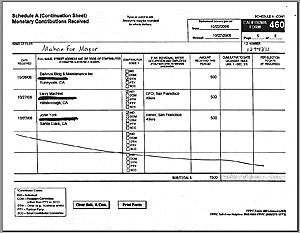
John York and Larry MacNeil (the 49ers owner and CFO, respectively) both contributed to Mayor Mahan's 2006 campaign. Both men gave the maximum amount.
Legal? Yes. Ethical? You decide.
It gets better. Jed York claims to be unaware of the contributions from his father and the 49ers CFO. However, he just happens to know exactly what the maximum allowed amount is. What's more, Mr. York also said:
FOR SALE: Councilmembers, like new, $500 each.
--
Campaign contributions are public records. You can look at them here. Search for "Mahan" or any other candidate, or browse by election. The contributions referenced above can be found in the filing from "Mahan for Mayor," dated 10/31/2006, which is an FPPC Form 460, covering the period from 10/22/2006 to 10/27/2006. Look at page 5 of 6. Click on the small copy below for a larger version:
OK, quick show of hands, how many people know what is the maximum contribution you can make to a City Council candidate?
John York and Larry MacNeil (the 49ers owner and CFO, respectively) both contributed to Mayor Mahan's 2006 campaign. Both men gave the maximum amount.
Legal? Yes. Ethical? You decide.
It gets better. Jed York claims to be unaware of the contributions from his father and the 49ers CFO. However, he just happens to know exactly what the maximum allowed amount is. What's more, Mr. York also said:
If a politician can be bought for only $500, I would hate to be represented by them.
FOR SALE: Councilmembers, like new, $500 each.
--
Campaign contributions are public records. You can look at them here. Search for "Mahan" or any other candidate, or browse by election. The contributions referenced above can be found in the filing from "Mahan for Mayor," dated 10/31/2006, which is an FPPC Form 460, covering the period from 10/22/2006 to 10/27/2006. Look at page 5 of 6. Click on the small copy below for a larger version:
 .
.
Sunday, May 20, 2007
The Santa Clara Way
City Council member Dominic Caserta hit the nail on the head when he said,
The decision on building a stadium in Santa Clara — and the larger issue of how to develop the entertainment district — must shun politics, and be made in adherence to our principles of fiscal prudence, consensus building and democracy.
Let's examine these three important principles in detail.
Fiscal Prudence.
I used the 49ers waterfall financial model (slides 15 - 17 of 49ers Proposal) to see what it would take for Santa Clara to break even after 30 years. The Stadium Authority would have to net over $15M annually in non-49ers events just to break even. By the 49ers' own calculations, this would be almost impossible.
It was really interesting to see how this profits the 49ers. In addition to their football profits, the 49ers would get a cut of non-49ers events amounting to over $45M over the life of the stadium.
Wow. The stadium is looking pretty good for the 49ers... Their rent goes down. They get a high tech ballpark & guaranteed capital improvements — increasing their market value significantly. Plus, they make an additional $45M off the backs of Santa Clara — approximately $450 per person.
Sorry Sally, no new bicycle for you, Jed York needs a new yacht.
Consensus building.
A recent CBS5 poll showed that 55% of Santa Clara residents oppose building a new stadium if it meant using public funds. Rather than forcing through a stadium proposal that has so little public support, the city must build consensus on how to best develop the entertainment district.
Building consensus requires effort to develop a proposal that will be an asset to the community. It must bring in a diversity of venues that will ensure high utilization, attract a broad cross-section of the community and keep a large percentage of revenues in the city.
The 49ers proposal achieves none of these goals. By all estimates, the stadium will be utilized between 10 and 30 days out of the year. The remaining 335 days will leave the district with a dark hole that could gobble up every man, woman and child in Milpitas, and still have room for dessert.
Big empty places are scary. Only the foolhardy, the drunks and shady characters will find this behemoth an attraction.
Democracy vs. Politics.
The 49ers have politicized this discussion with their paid consultants and slick sales pitches to City Council and to the community.
Stop the politics. Insist on putting this critical issue before the people on a general election ballot.
We in Santa Clara do things very well. We're fiscally prudent and we make decisions based on consensus building and principles, not politics.
The decision on building a stadium in Santa Clara — and the larger issue of how to develop the entertainment district — must shun politics, and be made in adherence to our principles of fiscal prudence, consensus building and democracy.
Let's examine these three important principles in detail.
Fiscal Prudence.
I used the 49ers waterfall financial model (slides 15 - 17 of 49ers Proposal) to see what it would take for Santa Clara to break even after 30 years. The Stadium Authority would have to net over $15M annually in non-49ers events just to break even. By the 49ers' own calculations, this would be almost impossible.
It was really interesting to see how this profits the 49ers. In addition to their football profits, the 49ers would get a cut of non-49ers events amounting to over $45M over the life of the stadium.
Wow. The stadium is looking pretty good for the 49ers... Their rent goes down. They get a high tech ballpark & guaranteed capital improvements — increasing their market value significantly. Plus, they make an additional $45M off the backs of Santa Clara — approximately $450 per person.
Sorry Sally, no new bicycle for you, Jed York needs a new yacht.
Consensus building.
A recent CBS5 poll showed that 55% of Santa Clara residents oppose building a new stadium if it meant using public funds. Rather than forcing through a stadium proposal that has so little public support, the city must build consensus on how to best develop the entertainment district.
Building consensus requires effort to develop a proposal that will be an asset to the community. It must bring in a diversity of venues that will ensure high utilization, attract a broad cross-section of the community and keep a large percentage of revenues in the city.
The 49ers proposal achieves none of these goals. By all estimates, the stadium will be utilized between 10 and 30 days out of the year. The remaining 335 days will leave the district with a dark hole that could gobble up every man, woman and child in Milpitas, and still have room for dessert.
Big empty places are scary. Only the foolhardy, the drunks and shady characters will find this behemoth an attraction.
Democracy vs. Politics.
The 49ers have politicized this discussion with their paid consultants and slick sales pitches to City Council and to the community.
Stop the politics. Insist on putting this critical issue before the people on a general election ballot.
Subscribe to:
Posts (Atom)