There was a spirited crowd at Peterson Middle School on Wednesday night, eager to learn more about the most important City-wide initiative of the century -- Measure J, the Stadium Subsidy.
And, learn they did. Kolstad & Kennedy covered topics as varied as the technical minutia of redevelopment law, school financing, game-day public safety measures and the stadium's potential impact on our perilously overdrawn City budget.
They even discussed campaign finance reform:
While we were not able to capture every moment of the evening's proceedings, we have posted as much as we could on youtube, where you will find discussions on:
Sit back, grab a bag of popcorn & let the good times roll!
Showing posts with label subsidy. Show all posts
Showing posts with label subsidy. Show all posts
Sunday, May 9, 2010


Sunday, April 25, 2010
Stop the Bleeding -- Vote No on J!
With this year's $13.5 Million deficit (expected to grow further next year) the City of Santa Clara is sinking from the ranks of fiscally sound, well-managed cities. It's saddening that we may lose yet another guaranteed $5 Million per year in rent from our fabled theme park, Great America.
Saddening, but not surprising. We already provide an annual give-away of $2.5 Million to the San Francisco 49ers' in the form of below-market rent on their training center.
Measure J extends that deal and expands the loss. The San Francisco 49ers would rent a brand new, state-of-the-art stadium for 25% of fair market value of the land it sits on!
Worse, they'd pay only 14% of the land's fair market value during the first 10 years of operation. Over the next two years, as our deficits sky-rocket, they'd pay nothing.
Sunday, April 18, 2010
"Net Present Value" vs. "Actual Dollars"
Mayor Mahan & Councilmember Matthews have revolutionized the housing market with their discovery that "net present value figures ... are based on outdated economic assumptions" and that we should focus on "actual dollars" paid over 40 years!
Madam Mayor, I'll buy your home for $1 million -- a good $100,000 over the current market price. I'll pay you in 2050. Do we have a deal? Can you vacate by next Tuesday?
Fair Market Rent for the proposed stadium site is currently over $1.8 million per year. Even with the new Mahan-Matthews Math, that should be worth over $72 million in "actual dollars." Too bad the 49ers LLC only signed up for $40 million.
This is a bad deal -- with or without the lies the Mayor is spreading.
Sunday, November 4, 2007
A quick thought
If contributing $222,000,000 and 15 acres of land to a project AND assuming the risks of stadium operations were such a great deal, why can't the San Francisco 49ers find private investors willing to invest private money into this project?
The fact that they have turned instead to the City of Santa Clara to ask for a massive public handout for this project is perhaps the best evidence that this enormous gift of public money is a poor investment.
One of Silicon Valley's many claims to fame is its venture capital firms, and if the 49ers can't find private investors in this area (or anywhere else, for that matter) to partner with them, then they should not expect the City to provide the money for them.
The New England Patriots have proven that football stadiums can be built with little to no public assets. The 49ers should take a page from their play book.
Saturday, October 20, 2007
"Pay no attention to that man behind the curtain."
Former Mayor Gillmor, the power behind the throne in Santa Clara politics, publicly excoriated Cedar Fair this week. The owner of Great America apparently committed a whipping offense when it raised objections to the proposed stadium. Cedar Fair was "acting in [its] narrow self-interest," according to Mr Gillmor.
Let's draw an analogy.
Imagine you are renting a nice little bungalow. One day the landlord just shows up, unannounced, with a casino operator. They proceed to discuss building a card club, right where your garage is.
Would you be upset? Of course you would. You might even oppose the deal. Is that "acting in [your] narrow self-interest?" Most people would say, no probably not. Certainly nobody could blame you for your objections.
So here's Cedar Fair. The owner-operator of the Great America theme park has been renting land from the City for years. They have a long term lease. They pay a fair rent*, which is more than their neighbor, the SF 49ers, can say.
Now this neighbor wants to build a stadium where Cedar Fair's parking lot is. Apparently nobody got their agreement in advance. Cedar Fair understandably doesn't think this is such a great idea. Nobody can blame them for that.
Or can they?
Mayor Gillmor thinks he can. But since when does a private business have to act in anybody's interest but their stockholders'? It sounds brutal, but that's capitalism, which Mr Gillmor surely knows a thing or two about.
If this episode says anything, it is that the 49ers stadium deal is on life support. Why else would the éminence grise himself have to come out from behind the scenes to stump for it? The simple fact is that the 49ers are demanding an exorbitant subsidy from Santa Clara taxpayers. Furthermore, they are so fixated on the feeding trough that they forget to say "Pardon me" to their neighbors.
In the words of City Manager Jennifer Sparacino, we Santa Clarans should strive to treat all parties "fairly and equally, without special favors."
--
* Cedar Fair pays the city "at least $5.3 million annually in rent" for the Great America property. For their training camp next door, the 49ers pay "about $24,000 a year - less than what it costs to rent some two-bedroom apartments nearby."
Wednesday, October 10, 2007
One wild ride
Yesterday I wrote that the City Council should not spend any more money on studying the San Francisco 49ers' stadium subsidy request until the City had a signed agreement from Cedar Fair.
I didn't really expect the City Council to postpone this request for additional money, but today's press release from Cedar Fair — "Cedar Fair opposes proposed 49ers stadium" — is precisely the reason why the City of Santa Clara should have obtained a signed agreement with Cedar Fair before spending a dime of taxpayer money on studying the proposal.
Cedar Fair's opposition isn't a complete roadblock to the stadium proposal — in its press release, Cedar Fair states its willingness to "consider selling the remainder of its lease and all of its interest and assets to the City or 49ers for fair market value" — but its opposition completely changes the circumstances of the proposal. If the City Council still wants to move forward with this proposal, it needs to study the feasibility in light of these new conditions.
The San Francisco 49ers, however, were quick to provide an alternative plan — they'll just buy the theme park.
A couple of problems with this new proposal.
First, as Santa Clara's Deputy City Manager Carol McCarthy told the San Jose Mercury News "Any sale requires the city's approval and is contingent on having a class A theme-park operator . . . with proven financial ability to operate it."
So, to use a baseball metaphor, strike one.
Second, the San Francisco 49ers have asked the city for $222,000,000 in public assets plus 15 acres of land to build the stadium. If they don't have the money to build their own stadium, how can they afford a theme park? And if we the taxpayers are subsidizing their place of business, is our subsidy helping them to acquire more business assets? Should public money be used to help a wealthy team owner buy even more private assets?
Strike two.
Finally, in many of their presentations to city residents, the 49ers have tried to claim that they want the City to operate the stadium because they "are in the football business, not the stadium business." (My previous responses to that claim have been "our city isn't in the stadium business either" and "that's a little like Intel saying its not in the office building business." Intel certainly isn't in the office building business, but it didn't use that argument to try and convince the city to build an office for them.)
But if the 49ers don't want to be in the stadium business, why on earth are they considering a leap into the theme park business? Shouldn't they stick a little closer to their core competencies?
I'll call that strike three.
Is this latest theme park idea just a last-minute desperation strategy? Are the 49ers merely clinging to any shred of hope that this proposal is viable? Do the San Francisco 49ers need to keep up the image that the Santa Clara plan is viable in order to put pressure on San Francisco to complete its proposal? Once the San Francisco proposal is in place, will the 49ers still be talking about venturing into the theme park business?
Time will certainly tell, but until then, be sure your seat belt is fastened and keep your arms and legs inside the car at all times.
It looks like it's going to be a wild ride.
UPDATE:
According to Julie Patel's article in the Mercury News today — Niners eye new spot for possible stadium — there may be another option. The proposed stadium site would be moved to an overflow parking on the other side of San Tomas Creek. But if they used this site, the 49ers would need to resubmit all of their site plans and traffic analysis, and the City would have to develop a plan to replace the parking Cedar Fair would be losing.
So this is yet another reason the City Council should have received Great America's approval in writing before spending any money even studying this proposal. As Ms. Patel writes in her article: "Whatever happens, the shifting debate is bound to cost the city of Santa Clara more time and money, on top of the $500,000 approved to research a stadium."
Tuesday, October 9, 2007
Back to school

It's been almost three months since the City Council last had any public agenda item related to the San Francisco 49ers' request for the City of Santa Clara to contribute $222,000,000 in public funds for a football stadium (although it seems that they have been having plenty of closed-door meetings.)
Tonight, however, the proposal will be back in public session.
At this evening's meeting, the City Council will consider the request to spend an additional $185,000 in public money to continue to study this proposal.
In case you've lost track of the total to date, this new request will bring the total to an even $500,000. And of course that figure doesn't include all of the staff time that has also been spent on this proposal.
I'm certainly in favor of study and research in general, but before continuing to spend any more money studying this proposal, the City Council needs to get back to the Guiding Principles it established for itself back in January.
One of those principles was a requirement that Cedar Fair agree that they will not assert business interference or negative effects from the feasibility studies and that this agreement needed to be in place "prior to pursuing discussions with the 49ers."
The City does not yet have that agreement.
So, the problem with spending money NOW on a feasibility study is that conditions may change by the time Cedar Fair is willing to agree to moving forward with a stadium without any reduction in their payments to the City or any City agency.
Therefore, we shouldn't be spending money on a study now. We should wait until Cedar Fair has agreed in writing to not assert their own business interests. When Cedar Fair does sign such an agreement -- then we can take up the question of whether additional public funds should be spent studying it.
And there's one more issue.
The cost estimates in the San Francisco 49ers' proposal were based on the City Council approving the project in July 2007.
So once we have Cedar Fair's approval, the City Council needs to ask the San Francisco 49ers to submit a revised construction budget.
Once those two pieces are in place, then and only then should we even consider spending more money studying this proposal. Financial conditions can change, and there's no point determining whether or not the July 2007 estimate is feasible, since we are already well past that approval date.
What can you do?:
1. Attend the City Council meeting on TONIGHT at 7pm and speak out! Speakers will probably be limited to 2 minutes each.
2. Call the Santa Clara City Council at
(408) 615-2250
3. Write a Letter to:
Patricia M. Mahan, Mayor
City Hall
1500 Warburton Avenue
Santa Clara, CA 95050
4. Send an email to:
mailto:MayorandCouncil@ci.santa-clara.ca.us?subject=Concerns%20about%20stadium%20proposal
5. Spread the word! Tell your neighbors and friends and encourage them to get involved!
Thursday, August 16, 2007
The Odd Couple, or Here We Go Again
It's more than two months old this time and it's getting stale. But in fact, it's just a reprise of the idea that first floated to the surface back in January: A marriage of convenience between Al Davis' Raiders and the York family's 49ers.
Now, the problem isn't the Raiders themselves, but the team's owner, Al Davis, who has been hauling multiple parties into court and suing them since before the Raiders split from Los Angeles. Millions of dollars in legal fees have been squandered by all sides - and that level of litigiousness certainly makes this Santa Claran wonder why the idea is even being proposed - again.
We thought this was properly dealt with back in January by Raiders Chief Executive Amy Trask, who simply said in essence that the Raiders would be concentrating on the current season in a stadium they're simply thrilled with, and that they are not actively seeking out the 49ers as business partners.
But like a zombie, this 'joint stadium' idea has come to life once again, walking the streets by night and claiming more victims, many of them credulous 49er Faithful. This time, on May 29, a columnist from the Sacramento Bee blew some more zombie powder in the creature's face.
True 49ers-Raiders synergy? Not a chance - and to their credit, neither author above really attempts to make such a limp case. Rather, the 'sticker shock' of what will likely be a one-billion-dollar stadium proposed for our City of Santa Clara has some 49ers business-office people looking for more ways to make others feel their pain.
But what the article fails to underscore is that any such partnership of the Yorks and Al Davis makes Davis a partner of the City of Santa Clara as well. Santa Clarans should be looking at any such agreement with deep suspicion, based on Davis' past dealings with the County of Alameda. Such a cooperative venture involving Mr. Davis may turn out to be anything but "cooperative".
In fact, Al Davis' latest lawsuit against the NFL was finally thrown out by the California Supreme Court only on July 2. If all we have to look forward to in any future dealings with Mr. Davis is more frivolous litigation, this Santa Claran strongly suggests that our guest be handed his hat and escorted to the door.
Note also that the Raiders' lease at McAfee Coliseum is over in 2010; they'll have to do some real tap-dancing to keep themselves there year-to-year until 2012. But Alameda County and the City of Oakland are still on the hook for the $200M worth of debt they used to fix up the Coliseum in 1996 - and that debt, on which Oakland and the County pay roughly $11M per year, will not be retired until the year 2025.
The likelihood of the NFL allowing another franchise into McAfee, with two teams just down the road? Just about nil. If Lew Wolff does finally get the green light to move the A's to Fremont, only the Warriors will be left in the smaller Oracle Arena. We note a similar situation from the 1990s, when both the Rams and the Raiders left Los Angeles.
All of this makes one wonder how long the 49ers will commit to staying in Santa Clara. Now, that will be at least until Santa Clara pays off its obligations in the years 2033 or 2038, right? Hello?
You could also ask Oaklanders about their likely reaction to Al Davis and his Raiders skipping out on yet another dinner check in any move to Santa Clara - but you'll probably want your kids out of earshot first.
Now, there is an idea in the latest article that that should get honorable mention: Having Al Davis and the Raiders be full contributing partners in any stadium - as long as that lets the City of Santa Clara completely off the hook.
That's mere speculation on the part of one sportswriter right now. So kindly permit this reader to take his suggestion one step further: If the two teams prove they're serious about this - that they'll (1) finance the entire stadium cost privately, (2) assume total ownership of the stadium, (3) mitigate its use of all City services such as police overtime and (4) waive any and all tax abatements - this stadium opponent might get on board.
But if Al Davis, whose team is in financially worse shape than most of the other NFL franchises, jets down from Oakland demanding the currently-proposed level of corporate welfare from the City of Santa Clara, we residents should be up in arms: If the millionaire owners of the 49ers are not entitled to a public dole of over two hundred million dollars, the Raiders - after the litany of abuses by their owner in Oakland - certainly are not entitled to benefit from that giveaway either.
Al Davis could end up costing the City of Santa Clara a lot more than he's worth. Just ask the Alameda County Board of Supervisors.
Wednesday, August 1, 2007
From the inbox
It's been a few weeks since we've had the opportunity to open up our inbox and post an email from one of our readers, but I'm glad we have the chance to do so this week.
Today's letter comes from Santa Clara resident Susan H., who lives in a neighborhood very close to the location of the proposed stadium. She sent us a copy of the letter she sent to the Mayor and City Council, and we are posting it here with her permission:
It's no surprise that all of us at Stadium Facts share Susan's concerns about the impact a stadium would have on Santa Clara, and Susan summarizes these concerns well. For those residents who live in the immediate vicinity of the proposed stadium, those impacts are even more significant. The years of construction would be just the start. Once the stadium is opened, anyone who lives anywhere near the stadium will have to contend with street closures and restrictions, increased noise and traffic, and increased crime.
NFL football stadiums are not an asset to a neighborhood, and if property values in these neighborhoods fall, the city will collect less in property taxes. In fact, at least one study suggests that simply announcing plans to build a publicly-subsidized stadium can cause property values in the entire city to decrease.
In their study The Impact of Stadium Announcements on Residential Property Values: Evidence from a Natural Experiment in Dallas-Fort Worth, economists Carolyn A. Dehring, Craig A. Depken, II, Michael R. Ward found that
Every property owner in Santa Clara, especially those who live closest to the proposed stadium, should be concerned about this evidence.
We also support Susan's call for a public vote on any proposal that would require any public financing for or operation of a stadium. The City Council should WANT the support of the residents for any project of this size.
Thanks for writing Susan! I hope you'll continue to contribute to the discussion.
Today's letter comes from Santa Clara resident Susan H., who lives in a neighborhood very close to the location of the proposed stadium. She sent us a copy of the letter she sent to the Mayor and City Council, and we are posting it here with her permission:
Dear Mayor Mahan and Council Members,
We have been living in the area near the proposed stadium site for the past 30 years. We’ve seen changes such as new housing developments in place of where the stable used to be, and erection of the power stations, the Niners training camp and soccer field, as well as improvements to this area, especially the addition of Rivermark Plaza. All was fine and added value to a quality of life to the area residents.
However, I cannot see the benefit of having a stadium near our residential area because facts have always shown that property value will decrease in areas near any stadium, not to mention the noise pollution, environmental pollution, and excess wear and tear on our local roads, not to mention the decrease in the quality of life in our neighborhood. We certainly do not welcome the sound of construction going on for the next few years as well.
Since the City is planning to subsidize this project with public money, then it should be put up for a public vote. You need to allow the public to decide, not just amongst the Council. I urge you to place this up for a public vote for the sake of the residents in Santa Clara, as well as your integrity. This is a republic country and we should have a say so in how our tax dollars are spent. If you do not allow us to vote, then it would be no different from a dictatorship. I urge you to give this much reconsideration and thoughts. I am sure that you would want to leave a positive legacy, not a negative one. Thank you.
Sincerely,
Susan H.
It's no surprise that all of us at Stadium Facts share Susan's concerns about the impact a stadium would have on Santa Clara, and Susan summarizes these concerns well. For those residents who live in the immediate vicinity of the proposed stadium, those impacts are even more significant. The years of construction would be just the start. Once the stadium is opened, anyone who lives anywhere near the stadium will have to contend with street closures and restrictions, increased noise and traffic, and increased crime.
NFL football stadiums are not an asset to a neighborhood, and if property values in these neighborhoods fall, the city will collect less in property taxes. In fact, at least one study suggests that simply announcing plans to build a publicly-subsidized stadium can cause property values in the entire city to decrease.
In their study The Impact of Stadium Announcements on Residential Property Values: Evidence from a Natural Experiment in Dallas-Fort Worth, economists Carolyn A. Dehring, Craig A. Depken, II, Michael R. Ward found that
. . . a series of announcements regarding a new publicly-subsidized stadium in nearby Arlington, Texas, had a deleterious effect on residential property values in Arlington. In aggregate, average property values declined approximately 1.5% relative to the surrounding area before stadium construction commenced.
Every property owner in Santa Clara, especially those who live closest to the proposed stadium, should be concerned about this evidence.
We also support Susan's call for a public vote on any proposal that would require any public financing for or operation of a stadium. The City Council should WANT the support of the residents for any project of this size.
Thanks for writing Susan! I hope you'll continue to contribute to the discussion.
Monday, July 30, 2007
Cities and the stadium business
At his blog Field of Schemes, Neil deMause, co-author of the book Field of Schemes, recently summarized an excellent special report from the Baltimore Sun of the pitfalls of stadium ownership for cities. As he writes in his post Aberdeen: How not to build a stadium deal,
The experience of Aberdeen is a cautionary tale for any city considering the possibility of operating a professional sports stadium. As Aberdeen's current mayor said in 2005,
The San Francisco 49ers have requested not just $287,000,000 in public assets for the construction of the stadium. They have also requested that the City of Santa Clara create a Sports Authority, which would both assume an additional $330,464,000 in bond debt and operate the stadium.
And taking on debt and operating the stadium are two additional risks, as the experience of Aberdeen demonstrates.
I hope you'll read the full article at the Baltimore Sun website, but here are a few interesting highlights:
This is an important cautionary note — a full stadium does not equal profit for the city.
And these debts and operating losses are for a small, minor league stadium. The debt and potential for operating losses will be much bigger for an NFL stadium.
Under the current proposal from the San Francisco 49ers, the breakdown of revenue streams is the same, with the notable exception of stadium naming rights, personal seat licenses, concessionaire rights, etc. But these revenue streams are NOT profit for the Stadium Authority — the 49ers' proposal calls for the Stadium Authority to borrow against this expected revenue in order to build the stadium. Like the Aberdeen IronBirds, the San Francisco 49ers will make most of the money from the actual football games.
What's particularly interesting to me about these numbers is that even in the case of a minor league baseball team, cities look to spread the cost over a larger region. And Aberdeen pledged a little over half of its annual general fund budget to the project. The current San Francisco 49ers' proposal calls for Santa Clara to take on FOUR AND A HALF TIMES its annual general fund budget for a stadium. The scale of the subsidy request is simply shocking.
The trickle-down profit scenario outlined in the 49ers' proposal depends on not simply attracting other events, but making a profit from these events. If there is no profit from outside events, no money will be set aside for capital improvements, and I'm sure we can all guess who will be on the hook for those expenses.
We've seen the same sort of thinking here in Santa Clara. Instead of addressing the very real financial costs and potential risks, stadium supporters draw on such far-fetched comparisons as the Wright brothers and the moon landing.
Instead of such wishful thinking, we need to focus on the very real financial risks involved in the stadium business.
After all, if there was money to be made in operating a stadium, don't you think the 49ers would want to do that themselves?
It's an outstanding reminder that when it comes to stadium finance, it's increasingly less about who pays the initial bills than about who reaps the revenues down the road.
The experience of Aberdeen is a cautionary tale for any city considering the possibility of operating a professional sports stadium. As Aberdeen's current mayor said in 2005,
Municipalities, especially this one, shouldn't be in this type of business.
The San Francisco 49ers have requested not just $287,000,000 in public assets for the construction of the stadium. They have also requested that the City of Santa Clara create a Sports Authority, which would both assume an additional $330,464,000 in bond debt and operate the stadium.
And taking on debt and operating the stadium are two additional risks, as the experience of Aberdeen demonstrates.
I hope you'll read the full article at the Baltimore Sun website, but here are a few interesting highlights:
Every game has been a sellout since the 6,000-seat stadium opened in 2002. Companies such as Bank of America have paid to be sponsors. . . .
But even on days like this, when the city-owned stadium is packed, Aberdeen loses money.
This is an important cautionary note — a full stadium does not equal profit for the city.
The Harford County community owes $6.7 million in stadium-related debt, and millions in interest, on a payment schedule stretching to 2022. The city's stadium fund has posted operating losses that total more than $1 million since 2001, forcing Aberdeen to dip into its treasury.
And these debts and operating losses are for a small, minor league stadium. The debt and potential for operating losses will be much bigger for an NFL stadium.
In closed-door negotiations, Aberdeen signed over to the Ripken businesses most of the money to be made from the baseball games. City officials had intended to cover the bills in other ways, including fees, taxes and a deal with Nottingham Properties to develop adjacent land. But the city's contract with Nottingham contained no penalty for delay. The land remains mostly acres of dirt.
Under the current proposal from the San Francisco 49ers, the breakdown of revenue streams is the same, with the notable exception of stadium naming rights, personal seat licenses, concessionaire rights, etc. But these revenue streams are NOT profit for the Stadium Authority — the 49ers' proposal calls for the Stadium Authority to borrow against this expected revenue in order to build the stadium. Like the Aberdeen IronBirds, the San Francisco 49ers will make most of the money from the actual football games.
The city, with a general fund budget at the time of just $7.6 million, pledged $4 million.
Most minor-league stadiums are owned by larger jurisdictions that can spread the costs over bigger budgets - the situation in Prince George's County, where the minor-league stadium is overseen by a multi-jurisdictional authority.
What's particularly interesting to me about these numbers is that even in the case of a minor league baseball team, cities look to spread the cost over a larger region. And Aberdeen pledged a little over half of its annual general fund budget to the project. The current San Francisco 49ers' proposal calls for Santa Clara to take on FOUR AND A HALF TIMES its annual general fund budget for a stadium. The scale of the subsidy request is simply shocking.
The city was counting on a ticket tax and the potential for parking fees, advertising on a billboard and non-baseball events. The tax raised about $140,000 the first season, but the city had little success attracting concerts, banquets or similar functions. In 2002, those events brought in only $2,000.
The trickle-down profit scenario outlined in the 49ers' proposal depends on not simply attracting other events, but making a profit from these events. If there is no profit from outside events, no money will be set aside for capital improvements, and I'm sure we can all guess who will be on the hook for those expenses.
"The Ripken family has put Aberdeen on the map," said [Former Mayor Douglas S.] Wilson, after rattling off the names of major leaguers such as Orioles right fielder Nick Markakis who have passed through Aberdeen. "To create that in a small government, to be able to have a minor-league baseball team, I mean, it's pretty phenomenal."
We've seen the same sort of thinking here in Santa Clara. Instead of addressing the very real financial costs and potential risks, stadium supporters draw on such far-fetched comparisons as the Wright brothers and the moon landing.
Instead of such wishful thinking, we need to focus on the very real financial risks involved in the stadium business.
After all, if there was money to be made in operating a stadium, don't you think the 49ers would want to do that themselves?
Monday, July 16, 2007
Just $62,000,000 more
Since we started this website, we've consistently said that the actual public subsidy requested by the 49ers in their proposal is nearly $300,000,000 in total public assets. I explained that number in detail in a post entitled Real Money.
Of course, that amount doesn’t cover all the actual and potential costs — things like additional infrastructure improvements, property tax breaks, and lost opportunity costs — but it does include all of assets requested by the 49ers in their proposal.
While the Mayor, certain members of the City Council, and the 49ers have continued to claim that the requested subsidy is a mere $160,000,000, we have insisted that all of the public assets need to be counted.
Here is a video of Mayor Mahan using the incorrect $160,000,000 subsidy request figure on CBS5 TV, as recently as June 19. It's at the 1 minute 27 second mark of the report:
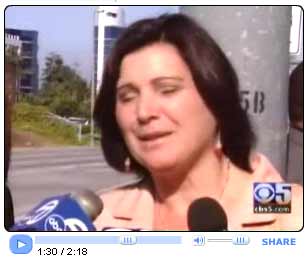
While the Mayor continues to use the incorrect number, the City of Santa Clara is beginning to agree with our estimates.
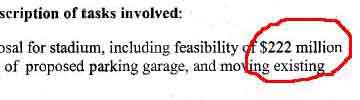
Buried in a report on the implementation plan and timeline for the "City of Santa Clara Principles & Priorities for 2007-09", which will be presented to the City Council tomorrow, is the City’s estimate of the requested subsidy.
$222,000,000
If you don’t want to do the math, that’s $62,000,000 — or about 39% — more than $160,000,000. This revised estimate of the subsidy includes the projected costs of both moving the electrical substation and the construction of a parking garage on the site, two items that were not included in the 49ers' $853,000,000 construction budget.
The new estimate still doesn't include the value of the land, but at least this number is closer to the true cost of the requested subsidy.
Pocket change, right?
You can view the report yourself from the city's own website:
http://cityclerkdatabase.ci.santa-clara.ca.us/wx/pubhtml/pubhtml/3009.html
It’s the report under Agenda Item 5F - Special Order of Business. The $222,000,000 is on page 15 of the report. Click on the image below for a PDF of the relevant page.
Once again, the City’s staff and consultants have provided a much-needed impartial analysis of this proposal, and we appreciate their hard work.
Of course, that amount doesn’t cover all the actual and potential costs — things like additional infrastructure improvements, property tax breaks, and lost opportunity costs — but it does include all of assets requested by the 49ers in their proposal.
While the Mayor, certain members of the City Council, and the 49ers have continued to claim that the requested subsidy is a mere $160,000,000, we have insisted that all of the public assets need to be counted.
Here is a video of Mayor Mahan using the incorrect $160,000,000 subsidy request figure on CBS5 TV, as recently as June 19. It's at the 1 minute 27 second mark of the report:
While the Mayor continues to use the incorrect number, the City of Santa Clara is beginning to agree with our estimates.
Buried in a report on the implementation plan and timeline for the "City of Santa Clara Principles & Priorities for 2007-09", which will be presented to the City Council tomorrow, is the City’s estimate of the requested subsidy.
$222,000,000
If you don’t want to do the math, that’s $62,000,000 — or about 39% — more than $160,000,000. This revised estimate of the subsidy includes the projected costs of both moving the electrical substation and the construction of a parking garage on the site, two items that were not included in the 49ers' $853,000,000 construction budget.
The new estimate still doesn't include the value of the land, but at least this number is closer to the true cost of the requested subsidy.
Pocket change, right?
You can view the report yourself from the city's own website:
http://cityclerkdatabase.ci.santa-clara.ca.us/wx/pubhtml/pubhtml/3009.html
It’s the report under Agenda Item 5F - Special Order of Business. The $222,000,000 is on page 15 of the report. Click on the image below for a PDF of the relevant page.
Once again, the City’s staff and consultants have provided a much-needed impartial analysis of this proposal, and we appreciate their hard work.
Wednesday, July 11, 2007
A fool's investment
Dave Zirin, a sportswriter who writes for the Nation, SLAM magazine, and the Los Angeles Times, among many other publications, has just written a new book — Welcome to the Terrordome: The Pain, Politics and Promise of Sports — in which he explores the intersections of professional sports and social justice in the world today.
He will be speaking at 7pm tonight [Wednesday, July 11] at Cody's Books in Berkeley. (Check the end of this post for more details about the reading. )

Not surprisingly, one of subjects he analyzes in this book is public funding for professional sports stadiums. He wrote about the same issue in an article for last Sunday's San Francisco Chronicle.
The entire article — Are stadiums worth the high price? — is worth reading, but here are a few highlights:
We've already seen evidence of those refined blackmail skills in Santa Clara. The headline alone — Santa Clara risks losing more than a 49ers stadium: 49ers HQ in play if deal collapses — neatly summarizes the start of a campaign to blackmail the city of Santa Clara into approving this enormous public subsidy for billionaires.
Of course, the fact that the San Francisco 49ers pay the City just $24,000 PER YEAR to lease the 11-acre property should be evidence that the City already provides a significant subsidy to this team. Judging by the numbers presented at Tuesday's City Council meeting, the City should be getting closer to $2,500,000 - $3,100,000 PER YEAR for that land — that's over 100 times more than we're currently getting.
Later in the article, Zirin includes part of a conversation he had with Jim Bouton, a former Major League Baseball All-Star and the author of the memoir Ball Four. Bouton's assessment is even more damning.
The talk starts at 7pm at:
Cody's Books
1730 Fourth Street
Berkeley, CA 94710
(510) 559-9500
Click here for the event page.
He will be speaking at 7pm tonight [Wednesday, July 11] at Cody's Books in Berkeley. (Check the end of this post for more details about the reading. )

Not surprisingly, one of subjects he analyzes in this book is public funding for professional sports stadiums. He wrote about the same issue in an article for last Sunday's San Francisco Chronicle.
The entire article — Are stadiums worth the high price? — is worth reading, but here are a few highlights:
Stadiums are sporting shrines to the dogma of trickle-down economics. In the past 10 years, more than $16 billion of the public's money has been spent for stadium construction and upkeep from coast to coast. Though some cities are beginning to resist paying the full tab, any kind of subsidy is a fool's investment, ending up being little more than monuments to corporate greed: $500 million welfare hotels for America's billionaires built with funds that could have been spent more wisely on just about anything else.
. . .
As Neil DeMause, co-author of the book "Field of Schemes" said to me, "The history of the stadium game is the story of how, by slowly refining their blackmail skills, sports owners learned how to turn their industry from one based on selling tickets to one based on extracting public subsidies. It's been a bit like watching a 4-year-old learn how to manipulate his parents into buying him the new toy that he saw on TV; the question now is how long it takes our elected officials to learn to say 'no.' " [emphasis mine]
We've already seen evidence of those refined blackmail skills in Santa Clara. The headline alone — Santa Clara risks losing more than a 49ers stadium: 49ers HQ in play if deal collapses — neatly summarizes the start of a campaign to blackmail the city of Santa Clara into approving this enormous public subsidy for billionaires.
Of course, the fact that the San Francisco 49ers pay the City just $24,000 PER YEAR to lease the 11-acre property should be evidence that the City already provides a significant subsidy to this team. Judging by the numbers presented at Tuesday's City Council meeting, the City should be getting closer to $2,500,000 - $3,100,000 PER YEAR for that land — that's over 100 times more than we're currently getting.
Later in the article, Zirin includes part of a conversation he had with Jim Bouton, a former Major League Baseball All-Star and the author of the memoir Ball Four. Bouton's assessment is even more damning.
It's such a misapplication of the public's money. . . .It's going to be seen historically as an awful folly, and it's starting to be seen that way now, but historically that will go down as one of the real crimes of American government, national and local, to allow the funneling of people's money directly into the pockets of a handful of very wealthy individuals who could build these stadiums on their own if it made financial sense. If they don't make financial sense, then they shouldn't be building them.
If I was a team owner today, asking for public money, I'd be ashamed of myself. Ashamed of myself. But we've gone beyond shame. There's no such thing as shame anymore. People aren't embarrassed to take -- to do these awful things.
Of course, we certainly haven't seen any evidence of shame among the San Francisco 49ers and their supporters.
I've asked Dave Zirin if he could add a Santa Clara stop on his current book tour, and he's hoping to schedule a visit later this fall. But if you'd like to hear him sooner, the trip to Berkeley will be well worth it.The talk starts at 7pm at:
Cody's Books
1730 Fourth Street
Berkeley, CA 94710
(510) 559-9500
Click here for the event page.
Thursday, July 5, 2007
Who really profits?
The San Francisco 49ers have been more than willing to talk about the potential economic benefits a stadium might have for Santa Clara and the surrounding region.
They haven't been quite so open about how they will benefit economically from that same new stadium.
Why not?
Well, it's probably because the value of their team will increase substantially if they get a new stadium — an immediate increase in value of somewhere between $250,000,000 and $700,000,000.
That's a much bigger increase than your average bathroom remodel.
How does the team's value increase?
Each year, Forbes magazine assesses the value of all 32 NFL teams. In their most recent list, the San Francisco 49ers are valued at $734 million — near the bottom of the pack (29th place.)
As Forbes states, this valuation is a reflection of the fact that "the 49ers have some of the lowest revenues in the league thanks to an antiquated stadium that features no club seating, and an onerous lease that forces the team to share concession, luxury-suite, naming-rights and signage revenue with the city."
A new stadium with a better revenue stream would increase the team's value. Could the new value go as high as $1.423 BILLION — Forbes' valuation of the Washington Redskins (and the team currently at the top of the list)? Maybe not. But it is certain that a new stadium with more favorable revenue stream would markedly increase the team's value.
Mike Swift at the San Jose Mercury News analyzed this very issue back in November 2006, shortly after the Santa Clara proposal was announced.
As he wrote in his article "Deluxe Stadium May Enrich 49ers"
By the way, it's worth noting that the new Patriots stadium (in Foxboro, MA, a town of about 16,000) was paid for ENTIRELY by the team's owner, Robert Kraft. [State taxpayers did finance about $75 million in infrastructure improvements, but the team is responsible for paying back that debt.]
As reporter David Copeland noted in his article "Patriots teach lesson about stadium financing",
We need to remember that professional sports are a big business, just like any other business, and the example of the New England Patriots is clear evidence that teams don't need public money to succeed.
They haven't been quite so open about how they will benefit economically from that same new stadium.
Why not?
Well, it's probably because the value of their team will increase substantially if they get a new stadium — an immediate increase in value of somewhere between $250,000,000 and $700,000,000.
That's a much bigger increase than your average bathroom remodel.
How does the team's value increase?
Each year, Forbes magazine assesses the value of all 32 NFL teams. In their most recent list, the San Francisco 49ers are valued at $734 million — near the bottom of the pack (29th place.)
As Forbes states, this valuation is a reflection of the fact that "the 49ers have some of the lowest revenues in the league thanks to an antiquated stadium that features no club seating, and an onerous lease that forces the team to share concession, luxury-suite, naming-rights and signage revenue with the city."
A new stadium with a better revenue stream would increase the team's value. Could the new value go as high as $1.423 BILLION — Forbes' valuation of the Washington Redskins (and the team currently at the top of the list)? Maybe not. But it is certain that a new stadium with more favorable revenue stream would markedly increase the team's value.
Mike Swift at the San Jose Mercury News analyzed this very issue back in November 2006, shortly after the Santa Clara proposal was announced.
As he wrote in his article "Deluxe Stadium May Enrich 49ers"
. . . in many markets, a new stadium has produced a windfall for owners.
Patriots owner Robert Kraft paid $172 million for the team in 1994. Today, with the Patriots playing in a new suburban Boston stadium partly financed by the NFL, in a market with wealthy demographics like the Bay Area's, the franchise is valued by Forbes magazine at $1.2 billion. That is the second-highest among the four major sports (football, basketball, baseball and hockey), more valuable than even the storied New York Yankees.
By the way, it's worth noting that the new Patriots stadium (in Foxboro, MA, a town of about 16,000) was paid for ENTIRELY by the team's owner, Robert Kraft. [State taxpayers did finance about $75 million in infrastructure improvements, but the team is responsible for paying back that debt.]
As reporter David Copeland noted in his article "Patriots teach lesson about stadium financing",
By conventional "wisdom" for financing sports stadiums, Kraft should be crying poor. That conventional wisdom says that teams -- no matter what the sport -- can't possibly pay for a new stadium on their own and remain competitive.
The Patriots finished the regular season with an NFL-best 14-2 record. On top of that, Forbes magazine valued the team at $756 million [in 2003] -- in large part because of the new stadium -- up considerably from the $158 million Kraft paid for the Patriots in 1994.
We need to remember that professional sports are a big business, just like any other business, and the example of the New England Patriots is clear evidence that teams don't need public money to succeed.
Sunday, July 1, 2007
"A gift of public funds"
City Council voted last week to foot the entire bill for repairing the streets in the South of Forest neighborhood. It was a difficult decision for some Councilmembers. Besides the fairness issue, there are the ever-present concerns about fiscal health.
Fairness is an issue because there are similarly-annexed neighborhoods that had to pay for their own improvements. Fiscal health is a concern because the City has been running pretty lean since the recession of 2002.
Understandably, many public figures voiced strong opinions, on both sides. "Simply put, this is a gift of public funds," said former Mayor Bill Gissler.
What's remarkable is that there may be an even bigger gift of public funds going out on Santa Clara's next sleigh. Yet we have not seen anywhere near the same kind of outrage, from any public figure, elected or otherwise.
In fact, it's quite the opposite. Many have been very willing to fall on their swords to fawn over the would-be beneficiaries of this gift. By the way, the reindeers are headed for Ohio, because these lucky boys and girls are not even Santa Clara residents!
Exactly how big a load is Rudolph hauling? Here's a comparison to bring it home.
Joe Average is just getting by. His savings are cleaned out. He was maxed out on his credit cards a couple of years ago, but he just managed to pay that off with careful budgeting. Still, Joe and his family are pretty much going hand-to-mouth on their annual income of $70,000. Joe's wife needs to replace her 1983 Dodge Omni. Joe buys her a 3-year-old Dodge Neon for $8,000. He has to take out a loan, because he doesn't have that much cash. Credit counseling will probably frown on that, but hey, it's either that or she can't get to her job. Then Joe buys for himself a brand new Ferrari F430 for $178,000, on credit.
You think that's far-fetched? This comparison is not at all hypothetical. Joe's salary is the same as the median income in Santa Clara. Joe Average can easily be our City.
Santa Clara is just barely running a surplus, and the forecast is for zero surplus by 2012 1. We had a budget deficit from 2003 to 2006. The General Fund Reserves are low. There is a hiring freeze on 30 staff positions 2. The SOFNA repairs cost $15M. City Council bit the bullet and committed to spending that money, even though it would probably mean deficit spending. Now the stadium proponents want Santa Clara to spend $297M to build a ballpark that will sit empty 11 months out of the year.
Look at the numbers in comparison:
--
1 City Council meeting minutes, May 15, 2007, section 4: Special Order of Business, item E: Joint Study Session on the Proposed Five-Year Financial plan for 2008-09 through 2012-13 and Proposed Capital Improvement Project Budget for FY 2007-08. Report, page 8 of 18.
2 Ibid, page 4 of 18.
Fairness is an issue because there are similarly-annexed neighborhoods that had to pay for their own improvements. Fiscal health is a concern because the City has been running pretty lean since the recession of 2002.
Understandably, many public figures voiced strong opinions, on both sides. "Simply put, this is a gift of public funds," said former Mayor Bill Gissler.
What's remarkable is that there may be an even bigger gift of public funds going out on Santa Clara's next sleigh. Yet we have not seen anywhere near the same kind of outrage, from any public figure, elected or otherwise.
In fact, it's quite the opposite. Many have been very willing to fall on their swords to fawn over the would-be beneficiaries of this gift. By the way, the reindeers are headed for Ohio, because these lucky boys and girls are not even Santa Clara residents!
Exactly how big a load is Rudolph hauling? Here's a comparison to bring it home.
Joe Average is just getting by. His savings are cleaned out. He was maxed out on his credit cards a couple of years ago, but he just managed to pay that off with careful budgeting. Still, Joe and his family are pretty much going hand-to-mouth on their annual income of $70,000. Joe's wife needs to replace her 1983 Dodge Omni. Joe buys her a 3-year-old Dodge Neon for $8,000. He has to take out a loan, because he doesn't have that much cash. Credit counseling will probably frown on that, but hey, it's either that or she can't get to her job. Then Joe buys for himself a brand new Ferrari F430 for $178,000, on credit.
You think that's far-fetched? This comparison is not at all hypothetical. Joe's salary is the same as the median income in Santa Clara. Joe Average can easily be our City.
Santa Clara is just barely running a surplus, and the forecast is for zero surplus by 2012 1. We had a budget deficit from 2003 to 2006. The General Fund Reserves are low. There is a hiring freeze on 30 staff positions 2. The SOFNA repairs cost $15M. City Council bit the bullet and committed to spending that money, even though it would probably mean deficit spending. Now the stadium proponents want Santa Clara to spend $297M to build a ballpark that will sit empty 11 months out of the year.
Look at the numbers in comparison:
- The Neon for Joe's wife costs about 1/8 of their annual income. The SOFNA repairs cost about 1/8 of the City's annual revenues.
- Joe's Ferrari costs about 20 times more than his wife's Neon. The stadium will cost 20 times more than the SOFNA repairs.
- Joe's Ferrari costs 2.5 times their annual income. The stadium will cost 2.5 times the City's annual revenues.
- Ferrari parts and labor are ... well, you don't want to know. The stadium operating costs are ... well, "Trust us" said the 49ers.
--
1 City Council meeting minutes, May 15, 2007, section 4: Special Order of Business, item E: Joint Study Session on the Proposed Five-Year Financial plan for 2008-09 through 2012-13 and Proposed Capital Improvement Project Budget for FY 2007-08. Report, page 8 of 18.
2 Ibid, page 4 of 18.
Friday, June 22, 2007
A tale of two cities
A few weeks ago, I analyzed the numbers from a Mercury News article Running 49ers stadium a costly pitfall. In my post A Costly Pitfall, I provided one crucial number that was missing from the initial article — the PER CAPITA cost of the subsidy.
Using just the numbers provided by the Mercury News, Santa Clara's subsidy of $180 million (the Mercury News did not include land value or the parking garage in their total), the PER RESIDENT subsidy of $1,651 was more than THREE TIMES that of the next closest project.
But the story doesn't end there.
Because I relied on the numbers in the Mercury News article, I calculated that the per resident cost of the new stadium for the Arizona Cardinals was $210 per resident.
That number is not exactly right for a few reasons.
First, the stadium is actually located in a suburb of Phoenix — Glendale, Arizona. The population of Glendale is approximately 258,677.
Second, the Mercury News article indicated that the public subsidy for this $455.7 million project was $310 million, but they didn't really break down either of these numbers.
The $455.7 million includes ALL costs related to the construction — including both land acquisition and site improvements. If these costs were added to the current San Francisco 49ers proposal, the total would be just shy of $1 BILLION [about $981 million to be more exact.]
Moreover, the city of Glendale's share of the $310 million subsidy was $9.9 million.
Yes, you read that right. Glendale spent $9.9 million on the project, for a per resident subsidy of about $38.
So where did they get the remaining $300.4 million of public money?
The rest of the subsidy came from the Arizona Sports and Tourism Authority [ASTA], a municipal organization created by the Arizona State Legislature to promote sports and tourism in Maricopa County, the county in which Phoenix and its suburbs are located. The funds for ASTA contribution came from a voter-approved county-wide tax on hotels and rental cars.
[To be clear, I'm not in favor of new taxes, especially to subsidize facilities for privately-held corporations, but the current claim that Santa Clara can provide $180 million in cash with no new taxes and no impact to the general fund or utility ratepayers is wrong. The money has to come from somewhere, and it WILL have an impact either directly or indirectly.]
Sadly, however, the unfavorable comparisons don't end with $38 vs $2,600.
You see, the stadium in Glendale was built with a special field that rolls out so that the stadium can be used for multiple purposes. It also has a retractable roof, again making it suitable for a variety of uses.
And it is.
From August 4, 2006 through January 8, 2007, it hosted events on 110 of the 157 days — about 70% utilization as compared to less than 10% using the most optimistic numbers in the current San Francisco 49ers proposal.
Maybe these numbers will help Santa Clara realize that it's time to do a bit of comparison shopping — and if we still decide to buy, maybe we can get a few friends, like Santa Clara County, to chip in on this purchase.
After all, if the claimed benefits are regional, then the costs should be shared by the region. Glendale didn't shoulder the cost for all of Maricopa County, and the City of Santa Clara cannot and should not assume the entire public expense and risk for this stadium.
Subscribe to:
Posts (Atom)