Monday, July 30, 2007

Cities and the stadium business

At his blog Field of Schemes, Neil deMause, co-author of the book Field of Schemes, recently summarized an excellent special report from the Baltimore Sun of the pitfalls of stadium ownership for cities. As he writes in his post Aberdeen: How not to build a stadium deal,

It's an outstanding reminder that when it comes to stadium finance, it's increasingly less about who pays the initial bills than about who reaps the revenues down the road.

The experience of Aberdeen is a cautionary tale for any city considering the possibility of operating a professional sports stadium. As Aberdeen's current mayor said in 2005,

Municipalities, especially this one, shouldn't be in this type of business.

The San Francisco 49ers have requested not just $287,000,000 in public assets for the construction of the stadium. They have also requested that the City of Santa Clara create a Sports Authority, which would both assume an additional $330,464,000 in bond debt and operate the stadium.

And taking on debt and operating the stadium are two additional risks, as the experience of Aberdeen demonstrates.

I hope you'll read the full article at the Baltimore Sun website, but here are a few interesting highlights:

Every game has been a sellout since the 6,000-seat stadium opened in 2002. Companies such as Bank of America have paid to be sponsors. . . .

But even on days like this, when the city-owned stadium is packed, Aberdeen loses money.

This is an important cautionary note — a full stadium does not equal profit for the city.

The Harford County community owes $6.7 million in stadium-related debt, and millions in interest, on a payment schedule stretching to 2022. The city's stadium fund has posted operating losses that total more than $1 million since 2001, forcing Aberdeen to dip into its treasury.

And these debts and operating losses are for a small, minor league stadium. The debt and potential for operating losses will be much bigger for an NFL stadium.

In closed-door negotiations, Aberdeen signed over to the Ripken businesses most of the money to be made from the baseball games. City officials had intended to cover the bills in other ways, including fees, taxes and a deal with Nottingham Properties to develop adjacent land. But the city's contract with Nottingham contained no penalty for delay. The land remains mostly acres of dirt.

Under the current proposal from the San Francisco 49ers, the breakdown of revenue streams is the same, with the notable exception of stadium naming rights, personal seat licenses, concessionaire rights, etc. But these revenue streams are NOT profit for the Stadium Authority — the 49ers' proposal calls for the Stadium Authority to borrow against this expected revenue in order to build the stadium. Like the Aberdeen IronBirds, the San Francisco 49ers will make most of the money from the actual football games.

The city, with a general fund budget at the time of just $7.6 million, pledged $4 million.

Most minor-league stadiums are owned by larger jurisdictions that can spread the costs over bigger budgets - the situation in Prince George's County, where the minor-league stadium is overseen by a multi-jurisdictional authority.

What's particularly interesting to me about these numbers is that even in the case of a minor league baseball team, cities look to spread the cost over a larger region. And Aberdeen pledged a little over half of its annual general fund budget to the project. The current San Francisco 49ers' proposal calls for Santa Clara to take on FOUR AND A HALF TIMES its annual general fund budget for a stadium. The scale of the subsidy request is simply shocking.

The city was counting on a ticket tax and the potential for parking fees, advertising on a billboard and non-baseball events. The tax raised about $140,000 the first season, but the city had little success attracting concerts, banquets or similar functions. In 2002, those events brought in only $2,000.

The trickle-down profit scenario outlined in the 49ers' proposal depends on not simply attracting other events, but making a profit from these events. If there is no profit from outside events, no money will be set aside for capital improvements, and I'm sure we can all guess who will be on the hook for those expenses.

"The Ripken family has put Aberdeen on the map," said [Former Mayor Douglas S.] Wilson, after rattling off the names of major leaguers such as Orioles right fielder Nick Markakis who have passed through Aberdeen. "To create that in a small government, to be able to have a minor-league baseball team, I mean, it's pretty phenomenal."

We've seen the same sort of thinking here in Santa Clara. Instead of addressing the very real financial costs and potential risks, stadium supporters draw on such far-fetched comparisons as the Wright brothers and the moon landing.

Instead of such wishful thinking, we need to focus on the very real financial risks involved in the stadium business.

After all, if there was money to be made in operating a stadium, don't you think the 49ers would want to do that themselves?

Sunday, July 29, 2007

What does Cedar Fair want?

Mark Purdy, one of our more thoughtful South Bay sports commentators, wrote a neat essay in the San Jose Mercury early Friday morning on the current rumble between Cedar Fair and the San Francisco 49ers. However, only in his last couple of paragraphs does he touch on the concerns that we Santa Clarans have about subsidizing a billion-dollar stadium with $222 million of public money. We certainly have no such "money" lying around. It will be nearly all public debt which we'll be paying off for many years - all to subsidize a millionaire football team owner.

Getting back to the article itself, Mr. Purdy notes: "Well, what about the opportunity for a theme park corporation to partner with the NFL and one of its most high-visibility franchises?"

I seriously question what kind of partnership that would be, as you'll have a different breed of customers for each venue. The expense of a stadium is so great, it is difficult to imagine that season and individual ticket sales alone will close the gap. Some form of "Personal Seat License" could well be imposed - and Great America visitors won't see the inside of any new stadium unless they shell out for a seat license like everyone else.

Before PSLs for the Oakland Raiders were finally eliminated in late 2005, they ran from $250 to $4000. When 10-game season tickets first took the place of PSLs in Oakland, they ranged from $470 to $910. A current seat map of McAfee Coliseum shows those same ten-game tickets now running from $260 to $1510. How any new "Stadium Builder's Licenses" will be priced for a new stadium in Santa Clara - not to mention the season ticket prices - is the stuff of pure speculation. Simply start with Oakland's example and work your way up from there. In the end, boosters of any stadium in Santa Clara may be in for a rude shock when season ticket - and possibly SBL - prices are finally posted.

Now, Mr. Purdy is right to question Cedar Fair's flip-floppy statements on the stadium proposal. But he appears to be saying that the current agreement on parking spaces for Great America gives Cedar Fair unfair veto power over the stadium. It does not. If Cedar Fair has plans for the future of Great America that would bump up its attendance figures - and fill up a parking area they're contractually entitled to - then they're well within their rights to insist that their needs be honored. Changing that agreement could force the City to accept less in revenue from (or agree to some cash compensation to) Cedar Fair. Either has an immediate negative impact to the City's General Fund - at the same time that compensating revenues from any football stadium are far from guaranteed. In short: A deal's a deal, guys.

Maybe Cedar Fair is as shrewd as Mr. Purdy seems to suspect. With that, here's pure speculation from this writer: Could Cedar Fair also be holding out for televised promotion of Cedar Fair theme parks around the country during 49ers games? It's amusing to contemplate our "roller coaster company" trying to make sense of the NFL's television blackout rules - rules designed to compel local ticket sellouts. In short, sell out your stadium 72 hours in advance of a game - or no game goes on the air for 75 miles. I'm oversimplifying this, I know. But it would sure be a kick if Cedar Fair were to find itself unable to promote Great America on TV in its own city due to poor ticket sales at the football stadium next door.

We could speculate on these corporate intrigues all day.

As a Santa Claran, however, I still oppose the stadium in general - and any corporate welfare for the millionaire Yorks in particular.

Our city - we taxpayers - will incur a debt of approximately $222,000,000.00 in order to hand that tribute over to the 49ers. Our debt service per year on any such amount will certainly wipe out the paltry $5M in rent the 49ers are offering to the Santa Clara Stadium Authority. That, plus those parking tax revenues dangled before our eyes, all accrue to the Stadium Authority - and not to the City's General Fund.

It gets worse: Depleted G-3 Fund or not, the Yorks are squeezing us for money so that they can then squeeze the NFL for more money. They want to use Santa Clara's money to improve their own cash flow and also to make their own private asset - the team - more valuble on the open market. Other NFL owners likely see such a rising tide lifting all boats, and you can be sure that they are delighted at such a prospect. That's still no reason to build a one-billon-dollar stadium in our city, and it's certainly no reason to hand millions in public monies over to a millionaire team owner who should be funding any stadium on his own or with the NFL.

But the worst problem with giving corporate welfare to the San Francisco 49ers is that it sets a dangerous precedent: Once we issue debt - or steal from the City's Utility Reserve - and hand those proceeds over to a private, for-profit sports franchise, we'll never be able to stop future "needy" millionaire welfare clients from doing the same thing. Their rationalization will be that, since we subsidized the York family from the public purse in 2008, we will have to do it again. And again.

We should be as concerned about that precedent as we are about Cedar Fair's parking spaces.

I do urge fellow Santa Clarans to beware - this is not the deal we think it is.

Wednesday, July 25, 2007

What about housing?

Sunday's Mercury News published a thoughtful and thought-provoking article. The author, John Conover, writes about the continuing and desperate need for more affordable housing in the Silicon Valley. No surprise there. What is of interest is that he writes from a business perspective -- he's a bank CEO. His argument is that more affordable housing is just plain good business:

In a global economy, business must be able to attract and retain top talent to be competitive. Yet with the median home costing $794,000 in Santa Clara County and $840,000 in San Mateo County, many middle-class workers are priced out of our market. Or they make a grueling commute for a few years, and then find jobs closer to where they can afford to live. Call it the "revolving door" of hiring. We've seen the quality of life in our communities erode as teachers, firefighters, police officers, and even our own adult children move away.
Given this obvious need, perhaps housing would be a better use of the land that many on our beloved council want to donate to the indigent York family. Talking just pure dollars and cents, would that benefit the city more than a massive multi-million dollar gift to a private corporation?

Increasingly, various communities have latched onto the idea of "smart growth," which according to Smart Growth Online "has
a greater mix of housing, commercial and retail uses" than the sprawl that typifies much of the development of the past half century. By comparison, smart growth development is less costly to maintain, especially when the costs incurred by environmental and social problems are also considered. Some smart growth developments take the form of "infill" development, using underutilized land already serviced by many city services and thereby maximizing the investment of those services.

What would be the long and short term benefits of providing housing in an area surrounded by shopping, entertainment, employment and mass transit? I would think that such benefits could be quantified, especially in relation to our strapped city budget. I'd hope that when the city staff comes out with their recommendations on this plan, that housing was at least considered as an alternative.

Tuesday, July 24, 2007

Stadium proposal discussion on KKUP 91.5 FM

Tomorrow morning — 7:00 am, Wednesday, July 25 — Don Cormier at KKUP 91.5 FM will be interviewing a couple of people regarding the proposed San Francisco 49ers stadium in Santa Clara.

I hope you'll tune in to the show!

Update: if you missed the show, click on the KKUP logo below for a recording (57MB MP3 file)

Monday, July 23, 2007

"A sense of compassion for the community"

When Santa Clara Mayor Patricia Mahan was interviewed for Santa Clara Magazine (published by Santa Clara University) in 2005, Mahan, who received a law degree from SCU in 1980, had this to say about her alma mater:

“They just imbue you with such a sense of compassion for the community ... the higher values and the better values of why you’re doing what you’re being trained to do. It’s not to make a million dollars a year. It’s to be of service.”

Mahan's
actions in recent City Council meetings, however, speak far louder than her words.

On several occasions in City Council meetings over the last few months, Mahan has used her position as Mayor to attempt to silence, demean, and disrespect Santa Clara residents who have taken the initiative to come forward and speak publicly about their concerns regarding the proposal to spend $287,000,000 in public assets on a football stadium for the San Francisco 49ers.

Usually, her biases are quite evident to everyone in attendance.

At the City Council meeting on July 17, however, the Mayor made an additional comment that was not heard in the Council chambers, but was quite audible to those watching from home.

"You're wasting your time."

The comment was directed at a resident who had wanted to speak to a report, but the Mayor rushed through the call for public comment without a pause. Instead of acknowledging that she had missed the resident's request, the Mayor blamed the resident.

You can see the full clip here:


Not only is such a reaction from the Mayor disrespectful, it's also a clear violation of Santa Clara's Code of Ethics & Values, which requires "all elected and appointed officials, City employees, volunteers, and others who participate in the city's government" to agree, in part, that:

3. As a Representative of the City of Santa Clara, I will be service-oriented. . . . :

a. I provide friendly, receptive, courteous service to everyone.
b . I am attuned to, and care about, the needs and issues of citizens, public officials, and city workers.
c. In my interactions with constituents, I am interested, engaged, and responsive.

6. As a Representative of the City of Santa Clara, I will be communicative. . . . :

a. I convey the City's care for and commitment to its citizens.
b. I communicate in various ways that I am approachable, open-minded and willing to participate in dialog.
c. I engage in effective two-way communication, by listening carefully, asking questions, and determining an appropriate response which adds value to conversations.

7. As a Representative of the City of Santa Clara, I will be collaborative.
In practice, this value looks like:

a. I act in a cooperative manner with groups and other individuals, working together in a spirit of tolerance and understanding. . . .

The real test of the City's commitment to ethics will be how they respond to the Mayor's actions, which certainly do not demonstrate "a sense of compassion for the community."

Monday, July 16, 2007

Just $62,000,000 more

Since we started this website, we've consistently said that the actual public subsidy requested by the 49ers in their proposal is nearly $300,000,000 in total public assets. I explained that number in detail in a post entitled Real Money.

Of course, that amount doesn’t cover all the actual and potential costs — things like additional infrastructure improvements, property tax breaks, and lost opportunity costs — but it does include all of assets requested by the 49ers in their proposal.

While the Mayor, certain members of the City Council, and the 49ers have continued to claim that the requested subsidy is a mere $160,000,000, we have insisted that all of the public assets need to be counted.

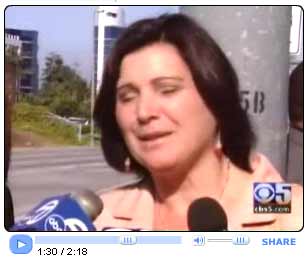
Here is a video of Mayor Mahan using the incorrect $160,000,000 subsidy request figure on CBS5 TV, as recently as June 19. It's at the 1 minute 27 second mark of the report:


While the Mayor continues to use the incorrect number, the City of Santa Clara is beginning to agree with our estimates.

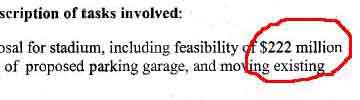
Buried in a report on the implementation plan and timeline for the "City of Santa Clara Principles & Priorities for 2007-09", which will be presented to the City Council tomorrow, is the City’s estimate of the requested subsidy.

$222,000,000

If you don’t want to do the math, that’s $62,000,000 — or about 39% — more than $160,000,000. This revised estimate of the subsidy includes the projected costs of both moving the electrical substation and the construction of a parking garage on the site, two items that were not included in the 49ers' $853,000,000 construction budget.

The new estimate still doesn't include the value of the land, but at least this number is closer to the true cost of the requested subsidy.

Pocket change, right?

You can view the report yourself from the city's own website:

http://cityclerkdatabase.ci.santa-clara.ca.us/wx/pubhtml/pubhtml/3009.html

It’s the report under Agenda Item 5F - Special Order of Business. The $222,000,000 is on page 15 of the report. Click on the image below for a PDF of the relevant page.


Once again, the City’s staff and consultants have provided a much-needed impartial analysis of this proposal, and we appreciate their hard work.

Sunday, July 15, 2007

"Ignorance is Strength"

When is an office development a winner, and when is it a loser?

If you're Councilmember Moore or Casserta, that depends on whether it's a project that competes with the stadium, or a project to make money for building the stadium. The San Jose Mercury News highlighted this Orwellian double-speak today. Here is a quote:
A few weeks ago, consultants said the city of Santa Clara could generate $3.3 million in annual rent if it built office buildings instead of a proposed San Francisco 49ers stadium.

Councilman Dominic Caserta challenged how legitimate the idea was, given the empty office buildings in other parts of the city.

And Councilman Kevin Moore, one of the first to approach the 49ers, joked that a sign advertising a strip of real estate across from the stadium site has been up so long that it's faded.

Last week, the same city consultants researched the idea of developing that very slab across the street and found it could generate as much as $2 million a year to help support the stadium or other city projects.

So why didn't Moore and Caserta have questions this time about how viable the option is?

You can read the full article here.

Note also that Councilmember Moore finally admitted that the stadium will sit empty and unused 300 days a year. Is that really what we want to spend $287 million to subsidize?